Rebranding a Startup Without Losing SEO and Brand Equity
Plan the rebrand strategy first, then build the redirects.
By the time someone opens the redirect map, most of the damage, or the protection, has already been locked in. The redirect is a consequence of decisions made earlier, in the strategy room rather than the server room: domain structure, URL architecture, which content survives, and when the whole thing goes live. It's a consequence of decisions made earlier, in the strategy room rather than the server room: domain structure, URL architecture, which content survives, and when the whole thing goes live.
Guidance published on inkbotdesign.com lays out three conditions that have to be true before a single redirect gets built. First, a complete inventory of every URL on the old site, because any page holding a link or ranking for anything needs a mapped destination. Nothing should route to a 404. Second, a deliberate decision about which content survives and which gets retired, because killing off a page that's quietly generating inquiries is a self-inflicted wound nobody notices until leads dry up. Third, a resolved brand identity: the new name, positioning, and service descriptions locked down before launch, not figured out live. If partners are still describing the company three different ways at relaunch, no redirect fixes that for Google, because the confusion Google has is about what the company actually is. It's about what the company actually is.
That third condition gates everything else, and most teams get the sequencing backward. Identity readiness is the precondition for the technical build meaning anything, not a parallel workstream that lags behind it. It's the precondition for the technical build meaning anything.
The same inkbotdesign.com guidance frames the pre-migration audit around a familiar ratio: identify the 20% of URLs generating 80% of a site's backlink value and organic leads. These are the equity pages, the ones the migration has to protect above everything else. The audit also needs to set performance benchmarks before launch, so whatever happens after can be read correctly as either normal fluctuation or actual structural damage.
One detail gets missed constantly. Staging environments need to be shielded from search crawlers using HTTP Basic Authentication, not robots.txt. A robots.txt file still allows URLs to be discovered, just not crawled in full, and an unfinished staging site can leak into the index anyway.
For a startup, this cuts both ways. Fewer URLs means a faster audit, but it also usually means a higher concentration of equity sitting in a small number of pages. Getting even one of them wrong costs proportionally more than it would for a company with a thousand pages to spread the risk across.
How 301 redirects work, and what they cannot do on their own
Google's own position, echoed in September 2026 inkbotdesign.com guidance, is that permanent 301 and 308 redirects do not cause PageRank loss. The signal transfers. That's Google's standing recommendation for any site making a URL-changing move, and it's correct as far as it goes.
The mistake, and it's a common one, is reading "redirects preserve equity" as though it means "redirects preserve rankings." Those aren't the same claim. A redirect protects the pipe. It says nothing about the meaning flowing through that pipe, and if the meaning changes, so does the ranking, redirect or no redirect.
The baseline is one-to-one mapping: every old URL points to its closest, most specific new equivalent. A blanket redirect that sends everything to the new homepage tells Google the old page has no real successor, and ranking signals scatter instead of transferring. Where a page genuinely has no equivalent on the new site, it should redirect to the most relevant surviving page, never to a 404.
Google's site-move guidance from inkbotdesign.com also flags something teams routinely forget: a domain move has to account for www and non-www versions of the old domain, plus any relevant subdomains, not just the preferred canonical hostname. Missing one of these is a common way for a chunk of the old link profile simply goes dark.
301s should stay in place for at least a year, giving Google time to recrawl old URLs and reassign signal from external links still pointing at them, sometimes for years after a migration. On cutover day, reducing DNS TTL, submitting fresh XML sitemaps, and using Search Console's Change of Address tool all reduce the number of moving parts, which makes it easier to diagnose anything that goes wrong afterward.
Some volatility is normal: a 5 to 10% traffic swing in the first two weeks, as Google works through re-indexing new URLs, isn't cause for alarm. A sustained drop above 30% a month out is the threshold where something structural has failed. That's the threshold where something structural has failed.
A redirect map can be technically flawless and still lose rankings, if the entity behind the URLs is telling Google a contradictory story. That's a separate problem, and touching a single redirect won't solve it.
Entity continuity: why Google re-evaluates trust during a rebrand, not just URLs
During a migration, Google isn't only remapping URLs. That process also involves re-deciding whether the entity behind those URLs is one it already trusts. A redirect is a technical instruction, not a sworn statement that the old brand and the new brand are the same business, and Google resolves that question separately, using signals a redirect simply can't carry.
Entity coherence depends on the same services being offered, the same people standing behind them, the same proof points, and corroborating profiles across the web that all tell a consistent story. When a rebrand changes the underlying offer at the same time as the name, the redirect can do its job perfectly and rankings will still move, because the thing being ranked is no longer the same thing.
The practical fix is timing. Organisation schema and third-party profiles need to update in the same window the redirects go live, not weeks afterward. sameAs markup, linking the new site's schema to the corresponding off-site profiles, tells Google directly that this is one continuous entity wearing a new name.
Contradictory information appears in the gap between updating the site and updating those off-site profiles, and equity gets lost there, unnoticed. Author profiles need similar care: update them with verifiable credentials that link back to the old brand's track record, rather than scrubbing that history clean. For ranking systems, history that gets deleted looks a lot like history that never existed.
Content scope discipline matters here too. A rebrand is tempting cover for a topic pivot, but drifting outside the existing niche risks breaking the topical coherence that built the site's expertise signals. Staying in the lane that earned trust protects those signals. Wandering off it during the one moment Google is already re-evaluating the entity is the wrong time to test new ground.
There's a user-experience risk hiding in here as well. If a returning visitor lands on the new site, doesn't recognize the brand, and bounces immediately, that behavioral signal reads as a negative to ranking systems. A clear bridge message for existing audience members, something that says "this is the same company, here's what changed and why," functions as a ranking protection measure in its own right.
Backlink reclamation after a domain change
Link decay gets called a silent ROI killer for good reason: even a redirect map with zero errors doesn't repair external links that have already gone stale or broken elsewhere on the web. A publisher's old article linking to the pre-rebrand domain doesn't update itself, and A link that resolves through a stale or broken chain provides diminishing value over time.
Reclamation is the deliberate process of finding those broken or outdated citations and getting them fixed at the source, so the entity trust already built into them stays intact. It's a different discipline from building new links, closer to inventory management than outreach in the traditional sense.
The results, done properly, are substantial. Data reported by stellarseo.com shows one Australian company that rebranded from a.com to a.com.au domain recorded a 350% increase in domain authority and a 1,377% increase in referring domains after a thorough reclamation effort. Realistic expectations for the outreach itself sit lower: research from vrid.ai puts the success rate for broken-link fix requests at 40 to 60%, when the request includes a clear replacement URL. The work compounds anyway, because reaching a long list of sources raises the overall fix rate even though any single source may not respond.
A travel brand case documented by stellarseo.com reclaimed 13 of 18 articles that mentioned its earlier identity, a 72% success rate, including one mention from a source with a domain authority of 67. That single high-authority reclamation likely did more for the domain's trust profile than dozens of smaller fixes combined, and that's the whole logic behind prioritizing by authority rather than working the list alphabetically.
Post-migration, the work doesn't stop at the reclamation list. Continuous log file analysis and regular indexation reports catch crawl errors early, and the first month after launch tends to set the trajectory for everything that follows. Startups get a break here that larger companies don't: a smaller backlink profile is genuinely tractable. A startup can realistically contact every domain linking to it. An enterprise with tens of thousands of referring domains cannot.
Brand equity continuity: the phased rollout that prevents customer defection
A five-stage framework published by inkbotdesign.com lays out the sequence for migrating brand equity: Audit, Asset Mapping, Migration Architecture, Phased Stakeholder Rollout, Technical Realignment. The order isn't cosmetic. Skipping a stage, or running them out of sequence, causes the whole structure to lose its load-bearing capacity.
Asset mapping, the second stage, means sorting every element of the existing brand into one of three buckets: Retain, Evolve, or Discard. The distinction that actually matters here is between elements that drive client acquisition and elements that are simply familiar. Familiarity feels valuable, but it isn't the same thing as an asset earning its keep, and confusing the two is where a lot of rebrand budgets get spent protecting the wrong things.
Migration architecture, stage three, follows a continuity principle: keep the legacy color, modernize the typography, retain the core positioning language customers already associate with the company. The goal is a bridge sturdy enough that existing customers can walk across it without noticing the gap underneath.
Stage four, the phased rollout, has a specific sequence: internal alignment first, then tier-one clients, then partners, and only then the public launch. Briefing top clients personally before anyone else finds out prevents the kind of churn a surprise announcement invites. If a top client reads about the rebrand in a press release before anyone from the company called them directly, the trust signal breaks. The commercial relationship existed before the brand did, but the brand is what that client points to internally when justifying the relationship to their own stakeholders, and stripping that reference point away without warning makes the relationship itself harder to defend.
Cracker Barrel's August 2025 reversal, after shares fell as much as 13%, works as the control case here. The company skipped the audience signal-testing step the phased rollout exists to catch, and the market answered immediately.
None of this creative work should start before a Brand Equity Audit that quantifies recognition, search equity, and client trust in concrete terms. That's a research document, not an aesthetic mood board, and treating it as the latter is where most rebrands go wrong before a single asset gets designed.
Startups tend to have less legacy visual equity than an established firm, fewer decades of logo recognition to lean on. But they usually have more concentrated founder trust, so the personal briefing stage in the phased rollout matters more for a startup, not less. When the founder is the brand in the client's mind, a press release doesn't substitute for a phone call.
Why AI visibility damage from a rebrand is harder to detect than ranking drops
Inkbotdesign.com guidance puts Google's AI Overviews at more than 2.5 billion monthly active users by May 2026, with AI Mode having crossed 1 billion. That scale changes what a rebrand actually has to protect, because search rankings are no longer the only place brand information gets consumed.
AI systems build brand descriptions by pulling together signals corroborated across many sources on the web. A rebrand that leaves contradictory profiles scattered around, one site calling the company by its old name, another citing outdated positioning, gives those systems contradictory raw material to work from. An AI answer confidently states an outdated or inconsistent version of the brand to a buyer who never clicks through to check it against the actual current website.
That's what makes this kind of damage worse than a ranking drop, not just different from one. A ranking drop appears in Search Console within days. An AI citation repeating the wrong name or an old positioning line can persist for months before anyone at the company notices, because nobody watches for it the way they watch a rank tracker.
The zero-click trend raises the stakes further. Similarweb data shows zero-click searches grew from 56% to 69% in a single year following the rollout of AI Overviews. A brand described incorrectly inside an AI-generated answer reaches buyers who will never visit the site at all, so the correct version never gets a chance to override the wrong one at the point of contact.
Gartner predicted in 2024 that traditional search engine volume would fall 25% by 2026. Writer.com's reporting found that prediction had already become reality by the time it was checked. Search equity and AI visibility equity aren't separate problems to solve in sequence anymore. A rebrand has to treat both at once, because the audience for one is increasingly the audience for the other.
Rebuilding AI visibility after a rebrand through entity schema and source diversity
Organisation schema functions as the structural bridge between an old identity and a new one in the eyes of AI systems: it defines the entity, name, logo, founding details, and sameAs links to verified external profiles. Reporting from digitalapplied.com states that Google's Gemini-powered AI Mode uses that schema markup to verify claims and judge source credibility while assembling an answer.
Entity disambiguation schema, meaning SameAs, knowsAbout, and Organization markup pointing to Wikidata, LinkedIn, and Crunchbase, meaningfully improves how well the Knowledge Graph recognizes an entity after a name change. The same digitalapplied.com reporting found that sites with complete Tier 1 schema saw up to 40% more appearances in AI Overviews, and that content carrying proper schema markup had a much higher chance of showing up in AI-generated answers.
Data from Erlin found that 68% of AI citations trace back to third-party sources, with only 32% coming from a brand's own website, which cuts against most people's intuition about where AI systems get their information. Data from Erlin found that 68% of AI citations trace back to third-party sources, with only 32% coming from a brand's own website. Owning the narrative on a company blog matters far less than getting cited elsewhere, so a rebrand strategy that pours all its energy into the new company blog aims at only 32% of the problem.
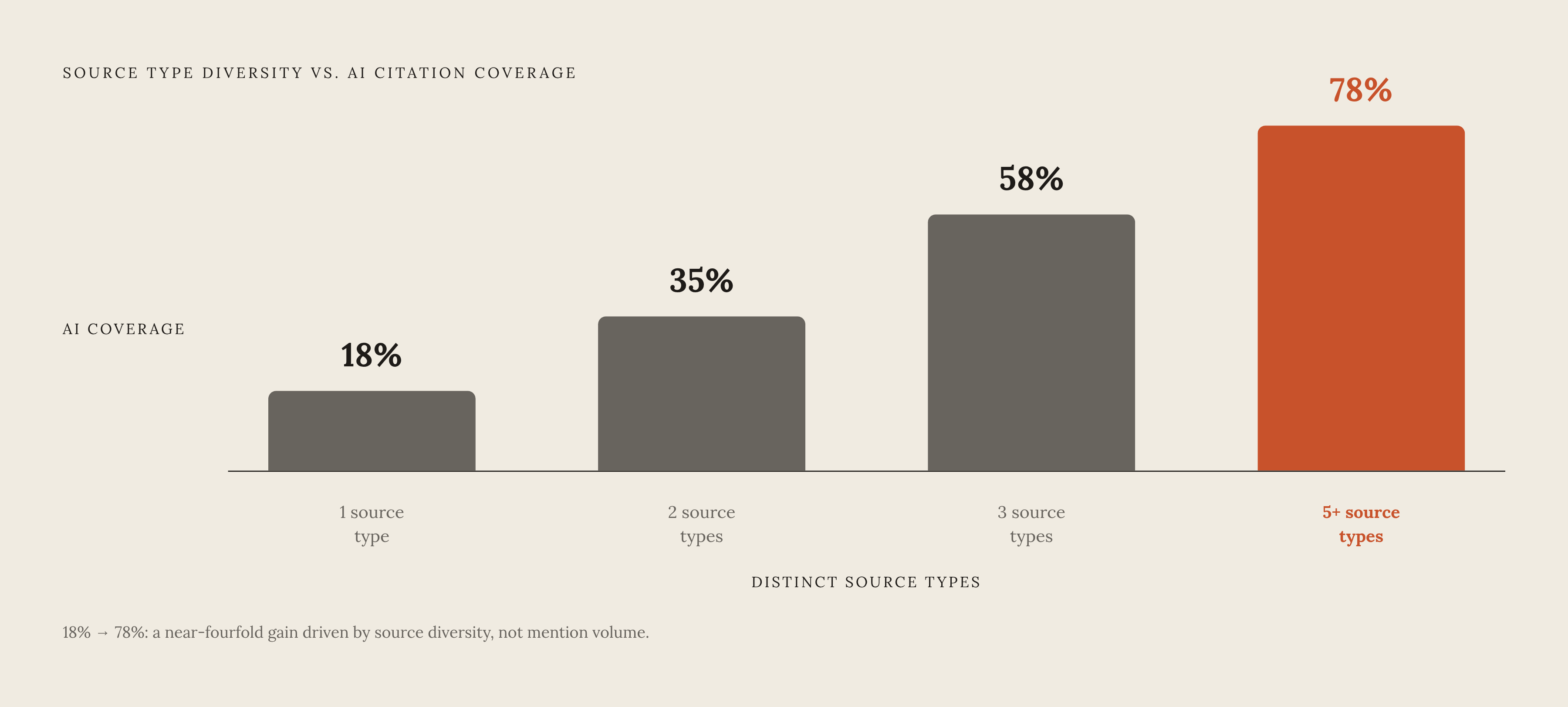
The same Erlin dataset breaks this down by how many distinct types of sources mention a brand. Coverage from a single source type averages 18%. Two source types bring that to 35%. Three types push it to 58%, and five or more source types get a brand to 78% average AI coverage. The pattern runs close to linear: diversity of source type, not volume of mentions, drives the visibility curve.
Data reported by Stacker shows that distributing content across a wide range of outside publications, rather than concentrating it on the brand's own domain, can increase AI citations by as much as 325%. Content built around verifiable statistics and named citations performs measurably better too. Princeton research reported via aisearch.similarweb.com found 30 to 40% higher AI visibility for content carrying real data points over content without them, and a joint study from Princeton, the Allen Institute for AI, Georgia Tech, and IIT Delhi, published as "GEO: Generative Engine Optimization" at KDD 2024, identified adding statistics as the single most effective tactic tested, improving AI visibility by 41%.
Brand mentions, even ones without a link attached, correlate far more strongly with AI visibility than backlinks do. Data from omnibound.ai puts the correlation for brand mentions at 0.664, against 0.218 for backlinks, roughly three times the strength. For a company mid-rebrand, that's the clearest signal available: getting the new name mentioned accurately and repeatedly across a wide set of independent sources does more for AI visibility than any amount of link-building aimed at the new domain alone.