Brand systems at seed stage: what to lock down before you scale and what to deliberately leave loose
Lock down your name and visual anchor; keep positioning and personality deliberately loose.

There is a peculiar kind of anxiety that descends on founders the moment someone uses the word "brand" in a board meeting. Suddenly, everything feels urgent and permanent. The logo becomes a philosophical commitment. The color palette becomes an identity crisis. And before long, someone has wired forty thousand dollars to an agency that produces a document so thorough, so laminated in its own seriousness, that no one on the team will ever actually open it again. I have watched this happen more than once. It is almost impressive.
Here is the thing most brand consultants will not volunteer, at least not until the invoice is signed: at seed stage, a brand system that is too rigid is nearly as dangerous as having no system at all.
Founders Are Solving the Wrong Problem
To understand why this keeps happening, we have to start with where the instinct comes from. Founders are pattern-matching to companies they admire. They see Stripe's meticulous design language, Notion's coherent visual identity, Figma's typographic precision, and they conclude that brand discipline is the cause of those companies' success. It is not. It is a byproduct of it.
Stripe did not achieve its standing because it had a perfect brand system at seed. It built one because it had enough product clarity, customer understanding, and revenue to warrant the investment. That sequence matters enormously, and conflating the two is how founders end up building infrastructure for a city that has not been founded yet.
But what if the early constraints you are locking down are foreclosing options you have not even discovered? That is the real risk. A founder who hard-codes a brand personality around "enterprise seriousness" in month three, only to find by month eighteen that their most profitable customers are mid-market teams who respond to warmth and approachability, has created drag that did not need to exist. The brand is now working against the business.
What Actually Needs to Be Locked Down
That said, the answer is not anarchy. Some elements, if left ambiguous, compound confusion in ways that become genuinely expensive to unwind.
The Name and URL
Lock this down quickly and without sentimentality. Renaming a product after you have a customer base, a press mention, or a sales deck circulating in the wild costs more than most founders anticipate: in time, in money, and in credibility. A name change signals instability to prospects and investors, regardless of the legitimate strategic reasoning behind it.
This does not mean the name must be clever or memorable on day one. It means it must be defensible, legally clearable, and capable of growing with the company's scope. Names that are too category-literal tend to age poorly as the product expands.
One Visual Anchor
Not a full palette. Not a complete type hierarchy. Not a suite of iconographic principles. One anchor, typically a primary color or a wordmark treatment, that allows anything the team produces to read as coming from the same source.
Why only one? Because constraints compound. Give an early team of three a loose "blue and gray" palette with four acceptable typefaces and two logo variants, and within six months you will likely have produced materials that look like they came from four different companies. Visual entropy is brutal and fast, and it accelerates precisely when a team is moving quickly and lacks the time to check the guidelines.
Voice Principles, Not Voice Rules
There is a meaningful distinction between a voice principle and a voice rule. A rule says: "Avoid the first person plural." A principle says: "We write like a knowledgeable peer, not an authority figure." One of these travels well across channels, formats, and team members. The other creates confusion the moment someone writes a LinkedIn post that does not fit the template.
Two or three voice principles, genuinely internalized by whoever is producing content, will tend to outperform a twelve-page tone-of-voice guide that no one reads past the first week. The guide feels like rigor. The principles actually produce it. That distinction is worth arguing about with your agency before you pay for the guide.
What Should Deliberately Stay Loose
This is where most brand frameworks fail the early-stage company, and where honest practitioners should say so more loudly. They frequently do not, because the billable work lives in the comprehensive deliverable.
Personality and Positioning Nuance
Your understanding of your customer will change, often dramatically, between seed and Series A. The emotional register you strike, the category you choose to compete in, the adjacent problems you choose to acknowledge: all of this is downstream of customer insight you likely do not yet have in sufficient volume.
Leaving positioning loose creates internal confusion about what the company stands for. That is not an unreasonable concern. But premature precision is its own form of confusion. Telling your team you are "the modern alternative to legacy enterprise software" when you are four months old and have eleven customers does not give them clarity; it gives them a phrase to repeat without understanding. There is a difference between those two things.
Secondary Visual Systems
Extended color palettes, illustration styles, motion design principles, iconographic systems: these matter at scale. They are legitimately premature before it. Companies that build these out early, absent the content velocity that would stress-test them, are answering questions the business has not yet asked.
That raises an important question: how do you produce materials in the meantime without things looking incoherent? Disciplined minimalism. Lean on the single anchor hard. Constraints that feel limiting at twenty employees will feel like relief at two hundred, because by then you will know exactly what you are constraining toward.
Channel-Specific Execution Norms
How your brand behaves on LinkedIn versus in a sales deck versus in a product tooltip should not be codified in month four. You have not yet determined which channels will carry the most weight, which audiences will matter most, or what content forms will earn the most trust from the people you are trying to reach. Locking in execution norms before you have that signal is guesswork in the costume of strategy.
A Framework That Actually Works in Practice
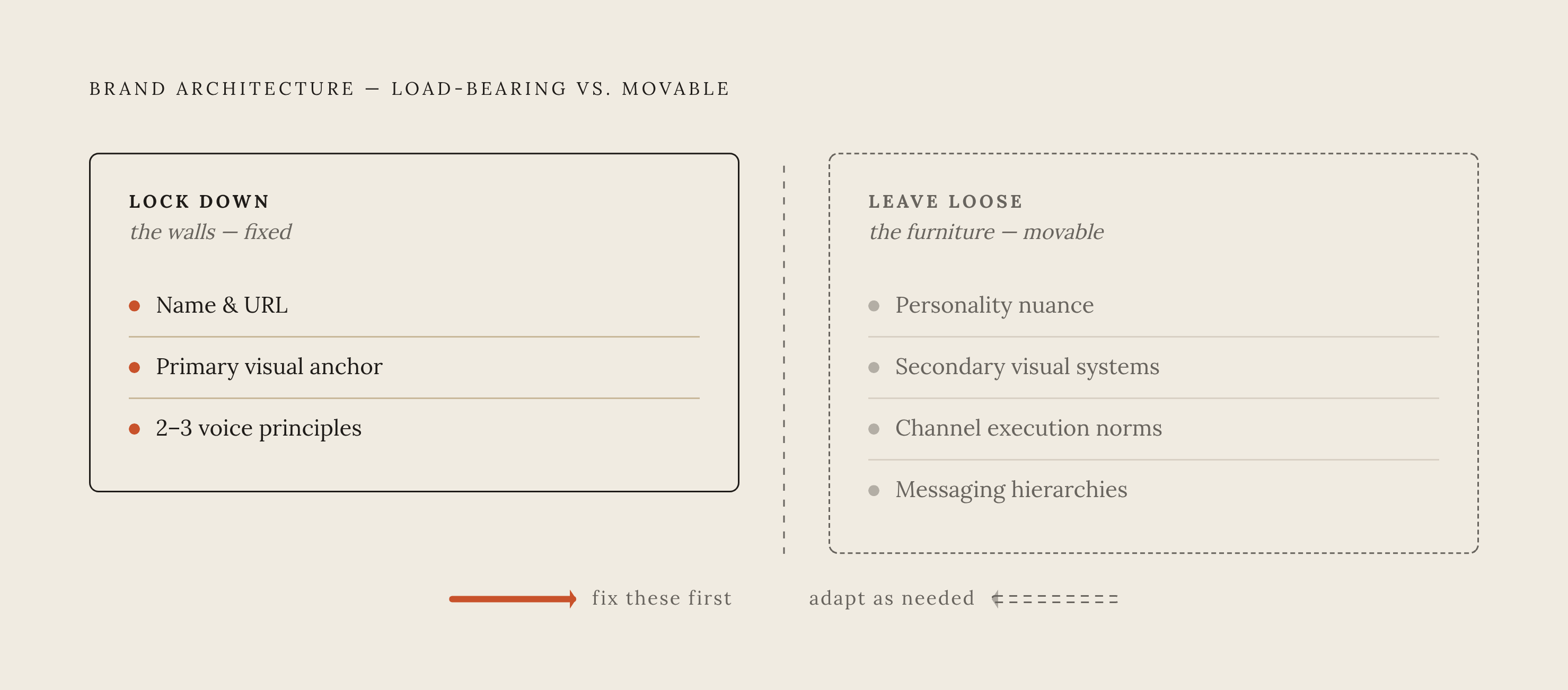
Think of early brand architecture as having two distinct layers. The first layer is load-bearing: the name and URL, the primary visual anchor, the two or three voice principles. These are the walls. Avoid moving them.
The second layer is non-load-bearing: personality nuance, secondary visual systems, channel norms, messaging hierarchies. These are furniture. Arrange them thoughtfully, but accept that they will move as you learn more about the space you are occupying.
A competent brand partner at seed stage will help you identify which layer a given decision belongs to before you commit resources to it. Crucially, that triage is itself the valuable service. Many founders do not know to ask for it, and many practitioners do not offer it because the comprehensive document is easier to justify on an invoice.
The Honest Answer to Why This Keeps Happening
Why do smart founders over-engineer brand at seed? Partly because it feels controllable at a moment when almost nothing else does. Brand guidelines are a deliverable. They can be presented to a board, sent to a new hire, shared with a contractor. They feel like evidence of institutional seriousness.
But brand seriousness and brand documentation are not the same thing. The most coherent early-stage brands I have encountered were coherent because the founding team shared an aesthetic sensibility and held a clear point of view on the customer. Not because they had ratified a style guide.
It is also worth considering that the founders who most aggressively over-invest in brand systems at seed are frequently the ones running from harder questions: Do we actually understand our customer? Is our product differentiated in ways that matter? Those questions cannot be answered by a deliverable. A brand bible can look like progress without constituting any.
The real discipline is not building a system comprehensive enough to govern everything. It is knowing which decisions are genuinely consequential right now, making those with care, and having the intellectual honesty to leave the rest open. That is harder than it sounds. It is also considerably more useful than a forty-page document that lives in a shared Google Drive folder no one has opened since onboarding.