Niche Positioning Strategy for Bootstrapped Startups
Bootstrapped founders win by dominating a narrow niche, not competing broadly.

Fewer than one in a hundred U.S. startups ever close a venture round. Qubit Capital puts the figure at 0.9%, which means the overwhelming majority of founders build without a term sheet, without a war chest, and without the runway to compete the way funded companies compete. That constraint isn't a footnote. It's the entire operating condition, and it changes what strategy even means.
Consider what "competing broadly" actually costs. Average monthly paid-search spend for mid-market and enterprise teams runs into the hundreds of thousands of dollars. A bootstrapped founder working with a few thousand dollars a month isn't losing that fight slowly. There's no fight. Stridec's analysis of bootstrapped versus funded AI startups draws the sharper line: funded companies sell a vision and ask customers to wait for the payoff, while bootstrapped companies have to sell proof and immediate return starting on day one, because nobody's underwriting the wait.
So the founder who tries to compete on feature count, ad spend, or brand recognition against a funded rival isn't fighting an uphill battle. They're fighting the wrong battle entirely, on a field built by someone else's balance sheet. And the clock is real: roughly 20% of startups don't make it past year two, and misallocating scarce resources chasing broad markets is one of the more reliable ways to land in that number. What follows isn't a motivational case for "finding your niche." It's a structural argument for why going narrow is the only mode of competition that makes sense under these constraints, and how to do it with enough rigor to survive scrutiny.
What niche positioning actually means in a bootstrapped context
Niche is not a demographic slice. It's the intersection of a specific problem, a specific type of customer, and a specific context where one solution is the obvious, credible answer, not a strong option among several.
The bootstrapped version of this idea departs from the version taught in marketing courses. Classic positioning theory is about brand preference: standing out in the customer's mind among a set of alternatives. The bootstrapped version is blunter. It's about becoming structurally hard to replace for a small group of people, so that switching away from you costs them something real.
That's why "SaaS for small businesses" and "inventory management software for independent bike shops" aren't the same strategy wearing different clothes. The first is a broad niche, which is really just a smaller version of a broad market, and it creates almost no defensibility. The second is a micro-niche, and it's defensible precisely because almost nobody else is bothering to build for bike shop owners specifically. Gartner's Q4 2025 SaaS Market Report found micro-niches growing 340% compared to broad-market platforms, which tells you this isn't a contrarian bet against the market. It's where the market has already gone.
Stridec frames bootstrapped positioning as proof over promise, and the operational detail that matters here is size: the niche has to be small enough to dominate, not just serve as one option among many. A related idea from entrepreneurloop.com holds that narrow focus reduces feature bloat, a clear value proposition attracts the right customers, and simple pricing removes friction from the sale. All three depend on the niche being specific enough that the founder can say exactly who it's for and why.
What niche positioning is not: a phase you grow out of once you raise money, a consolation prize for lacking resources, or a sentence on a homepage. It's the operating structure of the business.
How to identify a niche worth owning rather than just entering
Market size works differently once you're not chasing venture-scale outcomes. Entrepreneurloop.com's research on bootstrapped SaaS niches frames it as needing enough demand to sustain growth without needing massive scale to get there, pointing to a range that is large enough to reach profitability but small enough to actually dominate. Big enough to reach profitability. Small enough to actually dominate.
Four things worth checking before committing to a niche.
Competition depth first. High competition in the broad category doesn't mean the specific micro-segment inside it is crowded. The pattern that emerges from successful solopreneur SaaS products is consistent: the ones that gain traction tend to target micro-segments that larger competitors are simply ignoring, not fighting over.
Willingness to pay comes next, and it cuts both ways. Price too low and you need volume that makes acquiring each customer expensive relative to what they're worth. Price too high and you need sales processes, contracts, onboarding, that a two-person team probably hasn't built yet. The sweet spot is a monthly price that sustains a small operation without requiring an enterprise sales motion.
Then there's operational feasibility: does building for this niche match what the team can actually execute, not what the founder can picture on a slide. And market accessibility, meaning can these customers be reached affordably through communities, forums, and direct outreach, with validation happening in weeks rather than dragging out over quarters.
One signal is worth more than most spreadsheets: an existing community organized around a problem, with no product that speaks their language. Aspiration.marketing notes that niche audiences share a sub-culture and their own dialect, specific phrases, specific shorthand, and that vocabulary can be used to target messaging directly at them. If that community exists and nobody's built for it, that's the strongest indicator available.
The mistake to avoid is choosing a niche because it's small, mistaking scarcity of competitors for the presence of opportunity when it might just mean there's no demand at all. Before picking anything, the bootstrapping playbook's audit-before-action principle is worth following literally: map the team's actual skills, existing relationships, and domain knowledge first. Proximity to the customer's world is a resource in its own right, and it's one most founders forget to count.
Validating the niche before building the product around it
Validation isn't optional when there's no runway to absorb a wrong guess. Qubit Capital's research found that 60% of bootstrapped startups reach profitability within three years, against 35% of externally funded ones, and the discipline that limited resources force onto a founder is part of what produces that gap.
The core move is to test messaging before building anything. Find where the niche community already gathers, and listen before pitching them a single thing.
Social listening does a lot of the work here: monitoring forums, groups, and communities where the audience already talks about their problems, in their own words. Those words are both the validation signal and, later, the actual copy for the landing page. Pre-sales and freemium offers work as cheap instruments for the same purpose, a small spend on a testable prototype or landing page beats months of development followed by silence. And Stridec's research on bootstrapped positioning notes that customers in this position need to see measurable impact within 90 days, which sets a real deadline for how fast the value has to show up.
Account-based marketing logic applies even to validation: pick a handful of ideal customer profiles inside the niche, build messaging strictly for them, and their reaction will tell you more than a hundred survey responses ever could. Joining the community itself, without a sales pitch, and introducing the problem framing casually, watching whether people recognize themselves in it, is validation before a product even exists.
What kills this process is tracking the wrong numbers. Signups and page views feel like progress but tell you almost nothing. The bootstrapping playbook is specific about the real signal: activation, the move from signup to first meaningful use or purchase. That's the number that means something.
How a tight niche creates compounding advantages that wider positioning cannot
Trust, once earned inside a genuinely underserved community, is sticky in a way that's hard to overstate. The dynamic is straightforward: a community that trusts the first mover resists later entrants, even well-funded ones, because the relationship was already spoken for.
Word of mouth inside a tight niche moves fast and costs nothing. A small, specific community shares information densely, so a single recommendation reaches a disproportionate share of the total addressable market, something no paid channel can match at that price. Marketing spend compounds the same way: the narrower the audience, the higher the signal-to-noise ratio on every single campaign, so the same dollar or hour buys more.
Distribution becomes something close to a moat. A founder with a real relationship inside a niche community holds a form of distribution power that a well-funded competitor has to buy, expensively, and might never fully replicate. The research is direct about this: audience trust is one of the few moats capital can't purchase outright.
There's a regional data point worth sitting with. Central and Eastern Europe produces unicorns through bootstrapping at a rate of 31%, against just 7% in Western Europe, per the bootstrapping research. The "default alive" mindset that scarcity forces, and the efficient scaling habits that come with it, produce outsized outcomes rather than just survival. And the knowledge compounds on its own: a founder who learns exactly what messaging, format, and offer converts one specific customer type builds something reusable. Each new customer inside that niche gets cheaper to find and easier to keep than the last one.
Why niche positioning is increasingly the answer to AI-era competitive pressure
Feature-level differentiation stopped being durable somewhere in 2025. AI tools made it fast and cheap to copy what a product does, and the research brief covering this shift describes the conversation moving from differentiation toward defensibility, because differentiation alone no longer holds.
AI startups that grew on the strength of some novel capability now face fast followers with similar tools and more money behind them. The advantage has to live somewhere those followers can't simply rebuild over a weekend. What can't be replicated by default: deep trust inside a community, a working understanding of one specific customer's actual workflow, and the accumulated signal that comes from serving a niche consistently over time. Those are the durable assets the research points to.
Distribution, not product polish, increasingly decides who wins. The fastest-growing startups in 2025 built three things at once, per the research brief: an audience that trusts them, a community that keeps people from leaving, and partnerships that speed up growth. A tight niche is the fastest route to all three at once, letting a small team become the recognized authority inside a community, build retention through sheer familiarity, and attract partnership interest from adjacent players who want access to that same audience.
Meanwhile, every broad content channel has filled up with AI-generated material, and discovery itself is shifting, as ChatGPT, Gemini, and Claude become places people go to find answers instead of a search bar. That shift opens a specific kind of opportunity for niche brands, and it's worth its own section.
The asymmetric opportunity niche brands have in AI-driven search and discovery
Gartner predicted traditional search volume would fall sharply by 2026, and AI-powered discovery has since moved into a large share of buyer journeys as a primary channel, not a novelty.
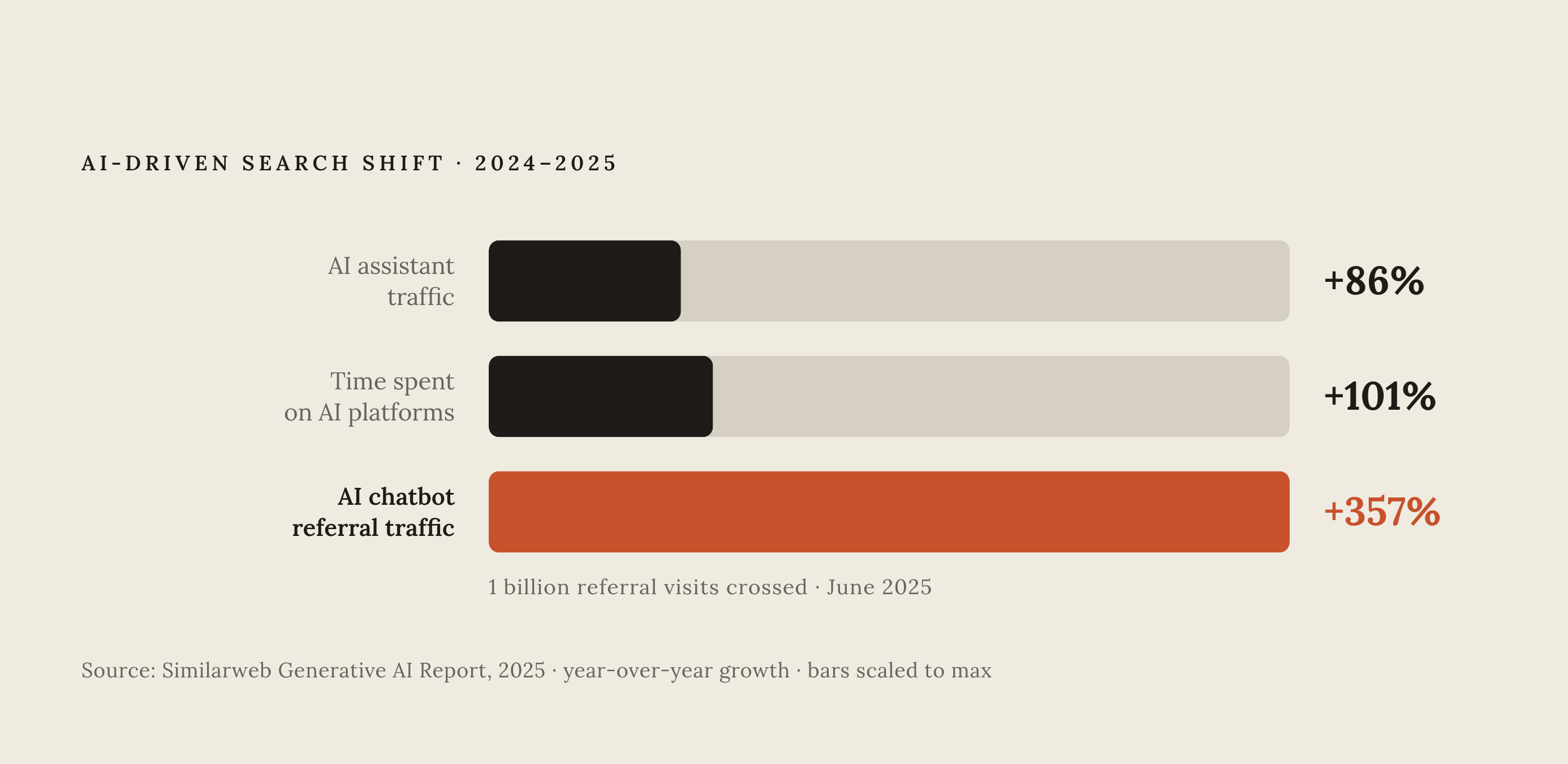
The scale of the shift is hard to miss in Similarweb's 2025 Generative AI report: AI assistant traffic rose 86% over the year, time spent on AI platforms rose 101%, and referral traffic from AI chatbots grew 357% year over year, crossing a billion referral visits in June 2025 alone. On the B2B side, a Wynter survey found 84% of B2B CMOs now using AI or large language models to find vendors, which means, for a bootstrapped B2B founder, that buyers are increasingly finding vendors through an AI-generated answer rather than a page of blue links.
Here's where the asymmetry favors the small player. AI systems are built to give specific, confident answers, and a brand deeply associated with one precise topic or community is more likely to get cited than a generalist with a bigger budget and a vaguer footprint. Stridec's research makes the point directly: niche authority is what earns placement in AI Overviews, not budget.
The research puts generative engine optimization at predominantly strategy, positioning, ecosystem presence, and brand authority, with only a small share attributable to technical execution. That ratio favors bootstrapped founders who can out-work funded rivals on substance and genuine community presence, even without a technical SEO team. Most enterprise marketing teams already had a GEO initiative running by early 2026, while most smaller operators had not yet started. That gap is the window, and it's open right now. Visibility in AI search comes down to frequency — how often a brand turns up across many different answers to many different prompts, and niche specificity is what drives that frequency up, because the brand becomes the canonical answer to one specific class of question instead of a maybe-answer to a hundred broad ones.
How to build content that earns AI citations and human trust simultaneously
Content built around verifiable statistics and named citations gets cited by AI systems 30 to 40% more often than unoptimized content, according to Princeton research cited in Similarweb's GEO analysis. Of every generative-engine-optimization tactic currently documented, that's the one with the clearest evidence behind it.
The implication for a niche founder is direct: original research, a small proprietary survey, a documented case study inside the specific domain, all of it earns AI citation frequency and human credibility at the same time, from the same piece of work. Jasper's analysis of GEO and answer-engine optimization lists what AI systems look for: content that's clear, backed by evidence, authoritative, and trustworthy. Those happen to be exactly the qualities a niche community already demands from a brand before it trusts it.
Authority doesn't live only on the company's own site. Social presence, press placements, and third-party mentions all feed into the ecosystem signals that AI systems read when deciding what to cite. Jasper's analysis also found that nearly 40% of Google's AI Overviews reference content that also ranks in the top 10 organic results, which means SEO fundamentals haven't gone away. They've just stopped being sufficient on their own.
For a niche founder specifically, the edge is depth. Broad content competes on volume, on having more pages about more things. Niche content competes on precision, on having the single best answer to one specific question, and AI systems reward precision when a specific question comes in. That matters more than it used to: Ahrefs' analysis of hundreds of thousands of keywords found that where AI Overviews appear, click-through rates for the top organic result drop substantially. Being cited inside the AI answer itself now counts for more than the ranking sitting below it.
Three priorities follow from this for a bootstrapped niche brand: document customer outcomes with real, specific numbers, publish guides so precisely useful that named people in the community would actually share them, and build a track record of citations in the publications that community reads.
How to defend a niche position once competitors notice you have built something worth copying
Feature replication got fast and cheap in 2025, so defensibility has to come from something structural, something outside the product itself. The research points to four forms that hold up: data advantages, network effects, distribution leverage, and community trust.
Community is the hardest of the four for a competitor to buy. Aspiration.marketing's research is clear on this point: even a better-funded entrant showing up later finds a crowd already committed to the brand that got there first, and displacing that loyalty takes more than a bigger budget.
Data compounds quietly. Serve one specific type of customer long enough and a founder accumulates real understanding of their workflows, their language, the specific ways their process breaks. That knowledge can't be purchased, and it stays invisible to competitors right up until they've already lost the account they were chasing.
Network effects can show up even in a small niche, if the product gets better as more niche customers use it, through shared templates, aggregated feedback, benchmarking against peers, community-built content. Each new customer under that structure makes the product harder to leave and harder to replace with something else.
And there's a commitment argument that funded competitors genuinely cannot make with a straight face: a bootstrapped brand can credibly promise it will never pivot away from the niche, because the niche is the entire business, not a beachhead on the way to something bigger. Funded competitors face pressure from investors to expand into adjacent markets the moment the niche looks tapped out, which means the niche founder who stays put isn't just being loyal. They're making a strategic bet that permanence itself is the moat, and for a business with nowhere else to go, it usually is.
Sources
- Bootstrapping Startup Playbook | 2026 EDITION
- 15 Best Bootstrapped SaaS Niches for Solo Founders to Target in 2026
- A Startup
- Bootstrapping Strategies That Help Startups Grow on Their Own
- Why Bootstrapped vs Funded Positioning Matters for AI Startups in 2026 - Stridec
- amsive.com
- aisearch.similarweb.com
- amsive.com