Repositioning a Startup After a Failed Product-Market Fit
How founders diagnose failed fit and move strategically.

43% of failed venture-backed startups cited poor product-market fit as the primary cause of death, according to CB Insights' 2024 analysis of over 400 shutdowns. That makes it the single largest killer, ahead of running out of cash, which is really just the symptom showing up on a bank statement months after the actual disease took hold. This piece is about what happens next: not the eulogy, but the operational sequence a founding team runs when the market they thought they understood stops responding the way it used to.
How to tell whether PMF actually broke — or was never real
Here's the uncomfortable possibility worth sitting with first: maybe PMF never existed, and what looked like traction was something else wearing its clothes. Early adoption driven by a founder's personal network, or by the novelty of trying something new, isn't the same as a market that needs what's being sold. Those early users are frequently the least representative people in the total addressable market; they'll forgive rough edges a mainstream buyer won't touch.
So how does a team tell the difference between weak fit and no fit? A few operational tells show up before the revenue numbers confirm anything. Constant tweaking of features or messaging with no corresponding lift in traction is one; a sales cycle that drags on and produces customers who use the product quietly but never refer anyone is another, since genuine product-market fit tends to generate word of mouth almost as a side effect. There's also a softer signal that founders notice last: key people start leaving, and the ones who stay seem tired in a way that has nothing to do with hours worked. Teams often sense market rejection well before the founder says it out loud.
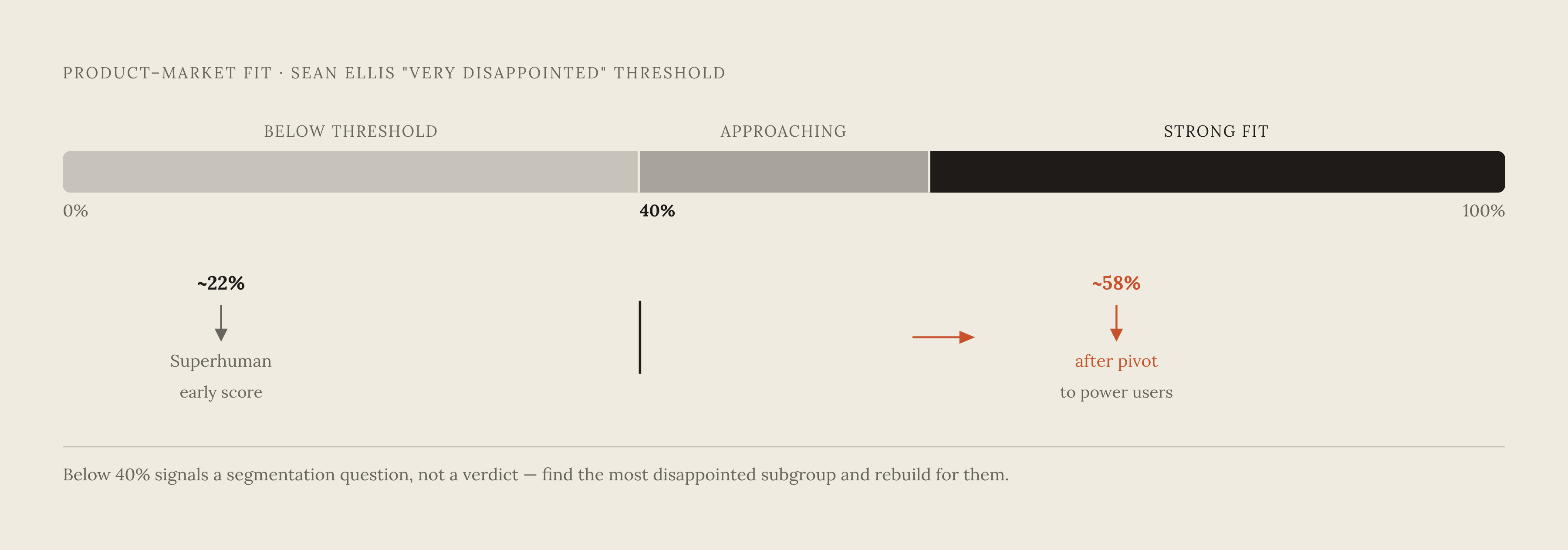
Fit isn't binary anyway; it sits on a spectrum. Weak fit looks like decent activation and a leaky retention curve, the product gets tried but doesn't stick. Strong fit feels closer to indispensable. The most widely used way to measure where a product sits on that spectrum is the Sean Ellis 40% Test: ask users how they'd feel if they could no longer use the product, and see what share says "very disappointed." Below a certain threshold, that's usually a signal to consider a real repositioning or audience pivot. In the middle range, fit is approaching but isn't there yet. Above 40%, the product has cleared the bar Ellis originally used to benchmark companies that went on to scale.
The email client Superhuman is the case worth knowing here, not because the initial score was good, but because it wasn't. The team scored well below the 40% threshold early on, then dug into which users were the most disappointed at the thought of losing the product. That subgroup turned out to be speed-obsessed professionals slogging through very high email volumes daily. Once the company built and marketed specifically for that profile, the aggregate score climbed into strong-fit territory. The lesson isn't the number; it's that the number is a starting point for a segmentation question, not an endpoint.
One more failure mode belongs here, separate from the diagnosis itself: premature scaling. Pouring marketing spend into a product before the retention curve has flattened doesn't fix a broken model, it just pays to acquire more people who'll churn on the same schedule as everyone before them. Current startup-failure frameworks list this as the top cause of death for a reason: it's expensive denial.
By the end of this diagnostic work, a founder should be able to answer one question honestly: is this a messaging problem, an audience problem, or a product problem? Each answer points toward a different kind of pivot, which is exactly what the next section untangles.
The pivot decision itself — when data says move, and what moving actually means
Pivoting is not a scarlet letter. Somewhere around 92% of startups pivot at least once before finding product-market fit, which means the exceptional case is the startup that never had to change direction, not the one that did.
Treating "pivot" as a single low-stakes word, though, hides a real risk. CB Insights research found that startups committing all their resources to an unvalidated pivot, all at once, without testing first, fail at a rate 4.1 times higher than those that validate before committing fully. That single number is the entire argument for sequencing: diagnose, audit, narrow, test, then commit. Skipping steps to move faster tends to produce the opposite of speed.
Timing matters as much as direction. Pivots triggered by a specific piece of market feedback, a customer behavior pattern, a churn cluster, a support ticket theme, are far better grounded than pivots triggered by general anxiety or a board member's offhand comment about the market shifting. Evidence-led and panic-led pivots can look identical in a deck. They are not identical in outcome.
Runway is the constraint that makes all of this concrete rather than theoretical. A pivot from selling to small businesses toward enterprise customers, for instance, usually means a much longer sales cycle; that requires runway to survive the gap before revenue catches up. A startup with four months of cash left doesn't have four months to test an enterprise motion that takes nine months to close a deal. The pivot doesn't rescue the runway problem in that scenario, it compounds it.
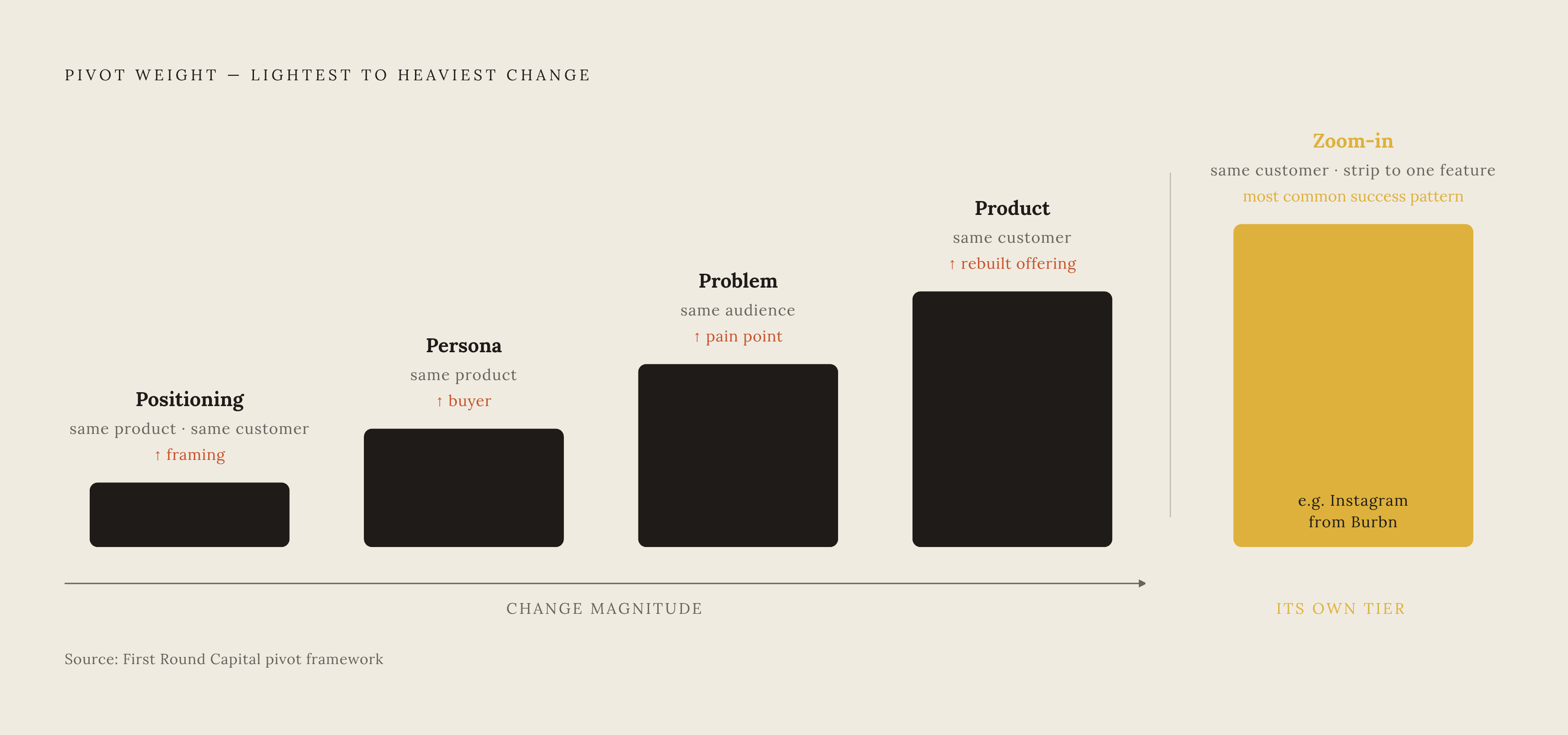
First Round Capital's framework for pivot types is useful precisely because it forces specificity instead of a vague "we're changing things." A problem pivot keeps the same audience but addresses a different pain point for them. A persona pivot keeps the product roughly the same but shifts the buyer, often because the actual demand turned out to be coming from somewhere the founder never targeted. A product pivot keeps the same customer but rebuilds the offering, typically because the original product solved a real but small problem and a bigger, adjacent one is sitting right next to it. A positioning pivot changes only the framing, the same product and the same customer, reframed. It's the lightest lift of the four, but only works when the product and the audience were correct all along and the story around them was wrong.
There's a fifth move worth naming separately because it's the most common successful pattern: the zoom-in pivot, stripping a sprawling product down to the one feature people actually love and rebuilding around that. Instagram's origin as Burbn, a check-in app that was stripped down to the one feature users actually loved, is the textbook version of this. The taxonomy matters because conflating pivot types is how founders end up changing the product, the customer, and the message simultaneously, which is less a pivot than a full reset with none of the original signal preserved to learn from.
Auditing what's actually working before touching anything
Before any of that gets decided, there's an audit, and it has to happen before strategy, not alongside it. The best repositioning decisions come from tracing revenue and retention to where they're actually concentrated, not where the founding deck said they'd be.
A handful of questions do most of the work here. Which customers renew without a sales team chasing them down? Where do support tickets cluster, and what does that cluster reveal about how people are actually using the thing? Which specific features get mentioned, unprompted, in every positive review or NPS comment? And a less flattering one: where did the team's actual hours and budget go this quarter, compared to what the roadmap said would happen?
All four questions point at the same underlying distinction: assumption versus evidence. What the team believed about the market when it raised money is a different document from what the usage logs and renewal data say now. The gap between those two documents is usually where the next move is hiding.
Pulley's early trajectory is a clean illustration. The company set out to build cap table management for startups broadly, which is a reasonable, big-sounding market. The audit of actual usage told a narrower story: it was very early-stage founders, tiny teams, who cared enough to abandon a spreadsheet they'd built themselves and switch tools. Narrowing to that specific niche, rather than the broad "all startups" framing, produced retention high enough to expand from later, on a foundation that actually held weight.
Worth being clear about what this audit is not. It isn't a feature prioritization sprint, and it isn't a customer satisfaction survey dressed up in new language. It's specifically about locating where genuine value exchange is already happening, so that repositioning builds on real ground instead of starting from a blank whiteboard and a founder's gut feeling.
Narrowing the ICP before any new messaging or product work begins
A 2025 framing on this is almost deceptively simple: even with AI reshaping how fast products get built and copied, the fundamentals of fit haven't changed. Define a specific ideal customer profile, solve an urgent problem for that exact group, and build a positioning story that makes clear why this particular team, and not the five others building something similar, is the right one to solve it.
Narrowing the ICP feels like giving something up. It reads, on a slide, like shrinking the total addressable market right when the company needs to look bigger, not smaller. Narrowing, though, is frequently the mechanism by which retention improves, referral behavior starts, and unit economics stabilize enough to justify expanding again later, from a position of actual strength instead of assumed strength.
A real ICP is more than a firmographic checklist. It names the specific trigger event that makes a buyer ready to act right now, a funding round just closed, a compliance deadline six weeks out, a headcount that just crossed a threshold that breaks the old process. It names the alternative the buyer is using today and exactly what's frustrating about it. And it distinguishes the internal champion, the person who'll evangelize the product internally, from the budget holder who actually signs the check; those are frequently two different people with two different sets of concerns.
For a persona pivot specifically, this document has to be detailed enough that sales, content, and product teams can each realign independently without a meeting to interpret it. A vague ICP update produces a vague pivot; everyone nods at the strategy offsite and then goes back to doing what they were doing before, because nothing concrete actually changed.
There's a quantitative reason to take vertical focus seriously too. Recent research found vertically focused products commanding meaningfully higher average contract values and customer lifetime values than horizontal equivalents solving the same general problem. If the audit turned up one industry using the product disproportionately, that's not a coincidence to note in a footnote; it's a direction.
Everything downstream, messaging, MVP scope, the sales motion, even the investor narrative, derives from this ICP work. That's why it sits here in the sequence, ahead of anything customer-facing gets touched.
Validating the new direction without rebuilding the whole product
Test the new thesis as cheaply as possible before engineering commits real time to it. That's the whole principle, and it's worth resisting the urge to skip it in the name of momentum.
CB Insights' research on resource allocation during pivots suggests keeping the bulk of engineering and product capacity on core operations, while assigning a minority slice specifically to validating the new direction. That split limits the downside if the thesis turns out wrong, which, per the 92% pivot rate mentioned earlier, is a live possibility worth planning around rather than hoping past.
In practice, validation looks smaller than most founders expect. A landing page built around the new ICP framing, paired with structured sales conversations, can show whether the new positioning actually changes buying behavior or just changes the words on a page. A stripped-down version of the repositioned product, put in front of the specific new segment identified in the ICP work, shows whether people use it the way the thesis predicted or whether they use it some other way entirely, which is itself useful information.
None of this works without kill criteria set in advance. What metric, at what level, within what window, confirms the direction or kills it? Setting that after seeing the results defeats the purpose; it's how founders talk themselves into keeping a thesis alive because they've already spent three months on it.
A validation window of roughly three to six months, with defined checkpoints inside it, keeps the test from drifting into an open-ended fishing expedition. If meaningful traction, customer interest, usage growth, early revenue, isn't showing up by the end of that window, that's data. Missing traction isn't a personal failure, nor is it proof the whole company is doomed; it's an answer to the question the test was built to ask.
Slack's origin is the case people reach for here, and it's worth being precise about why it fits. The internal communication tool wasn't a planned pivot with a validation window and kill criteria; it emerged from how the team was actually using something they'd built for another purpose. The decision that mattered wasn't cleverness, it was noticing the real evidence of value sitting right in front of the team and choosing to follow it instead of pushing further into the original thesis. The takeaway isn't "get lucky." It's "notice what's already working before assuming the fix requires starting over."
What separates credible validation from performative validation is the goal underneath it. The point isn't to confirm what the founder already believes; it's to try, honestly, to disconfirm it. A founder who can say precisely what result would prove the new direction wrong, and who actually goes looking for that result, is running a real test. Anyone else is just collecting evidence for a decision that's already been made.
Rebuilding the market thesis and updating investor communication
A pivot announcement is a brand story whether anyone intends it that way or not, and brand stories live or die on how they're sequenced and told. The identical underlying decision, changing direction based on evidence, can read as proof of intellectual honesty or as an admission of failure, and the difference is almost entirely in the framing, not the facts.
Investor communication around a pivot needs a few specific things in it. Lead with evidence, the actual signals that triggered the change, not a general statement about market conditions being tougher than expected. Include what was learned from the original thesis, since "we were wrong about X" is a weaker story than "we learned Y about the market, which the original thesis didn't account for." Update the financial projections honestly, reflecting the new timeline and the new capital needs, rather than papering over the delay. And state plainly why the new direction is a better path to returns for this specific team, given what they now know that they didn't know before.
Something has shifted in how investors weigh these moments, worth naming directly. "Backing the idea" has quietly given way to "backing the team's capacity to read and respond to signals," which means a well-run pivot narrative doesn't have to be a liability in an investor conversation. It can be evidence of exactly the quality investors are trying to underwrite in the first place.
Slack, Instagram, and the company that eventually became Twitter (started as Odeo) all handled their public pivots the same way structurally: emphasis on user behavior and market signal, emphasis on team conviction, and, notably, restraint about dwelling on what didn't work. None of them announced the new direction before there was early evidence behind it. The order matters as much as the content.
Repositioning works better as a managed transition than as a single press release moment. Organizations that treat brand repositioning as an ongoing stakeholder engagement, touching customers, employees, and investors over an extended period rather than a single announcement, tend to see more measurable shifts in perception and in commercial outcomes than those that try to do it in one announcement and move on.
Internal alignment can't be an afterthought here either. Employees absorb the pivot narrative before customers or investors ever see it, and how that internal conversation goes shapes whether the team commits to the new direction or just quietly drifts through it while waiting to see what happens. A founder who can say, plainly, that the original thesis was wrong and explain why the new one is better, gives the team room to actually commit instead of hedging.
Treating PMF as a recurring measurement after repositioning, not a finish line
Here's the error that tends to repeat: founders who just went through the trouble of diagnosing a broken fit, auditing the real signal, narrowing the ICP, validating cheaply, and rebuilding the investor story often turn around and treat the new fit as permanent too. Permanence, though, was never on offer.
Fit shifts as the customer base grows, as the feature set expands, and as competitors enter. What earned strong fit in one competitive environment doesn't automatically hold in the next one, and that's become sharper in an environment where AI-enabled competitors can close a capability gap in weeks rather than quarters. The moat that felt real at the moment of repositioning can be gone by the next board meeting.
An ongoing measurement practice is the practical answer to that. Running the Ellis survey on a fixed cadence, quarterly, or tied to major releases, rather than once at launch and never again, keeps the 40% threshold as a live number instead of a historical footnote. Tracking retention curves by cohort matters too; a curve that flattens is the most reliable early signal that fit is durable rather than temporary. Referral rate, tracked as its own behavioral metric, catches something surveys miss: customers who are genuinely well served tend to bring others in without being asked to.
InVision is the cautionary example worth sitting with here, not as a gotcha but as a timing lesson. The company was once valued at a significant multiple, and it did eventually pivot toward a digital whiteboarding product. The pivot, though, came late, and it came under-resourced relative to what the competitive window required, and by the time the new direction was actually underway, that window had largely closed. The lesson isn't that pivots are risky, every section above has already made that case. It's that a late, thinly resourced pivot produces a fundamentally different outcome than an early one built on evidence and given real runway to work.
The posture this entire process is pointing toward is proactive rather than reactive: founders who build PMF measurement into the normal operating rhythm of the company get to reposition ahead of a crisis, while there's still runway and still options, instead of being forced into it after both have run out. For the teams building the content and marketing infrastructure that supports a repositioning effort, the same logic applies one level up. Strategy-first workflows that can be updated and redeployed quickly hold more value over time than one-off campaigns built for a single announcement, because the market thesis is going to keep moving, and the speed of the narrative needs to keep pace with the speed of the product.