Essay Content Strategy
Repurposing a Single Piece of Content Across Six Channels
Most teams abandon 60 percent of a piece's value by not reshaping it for each channel.
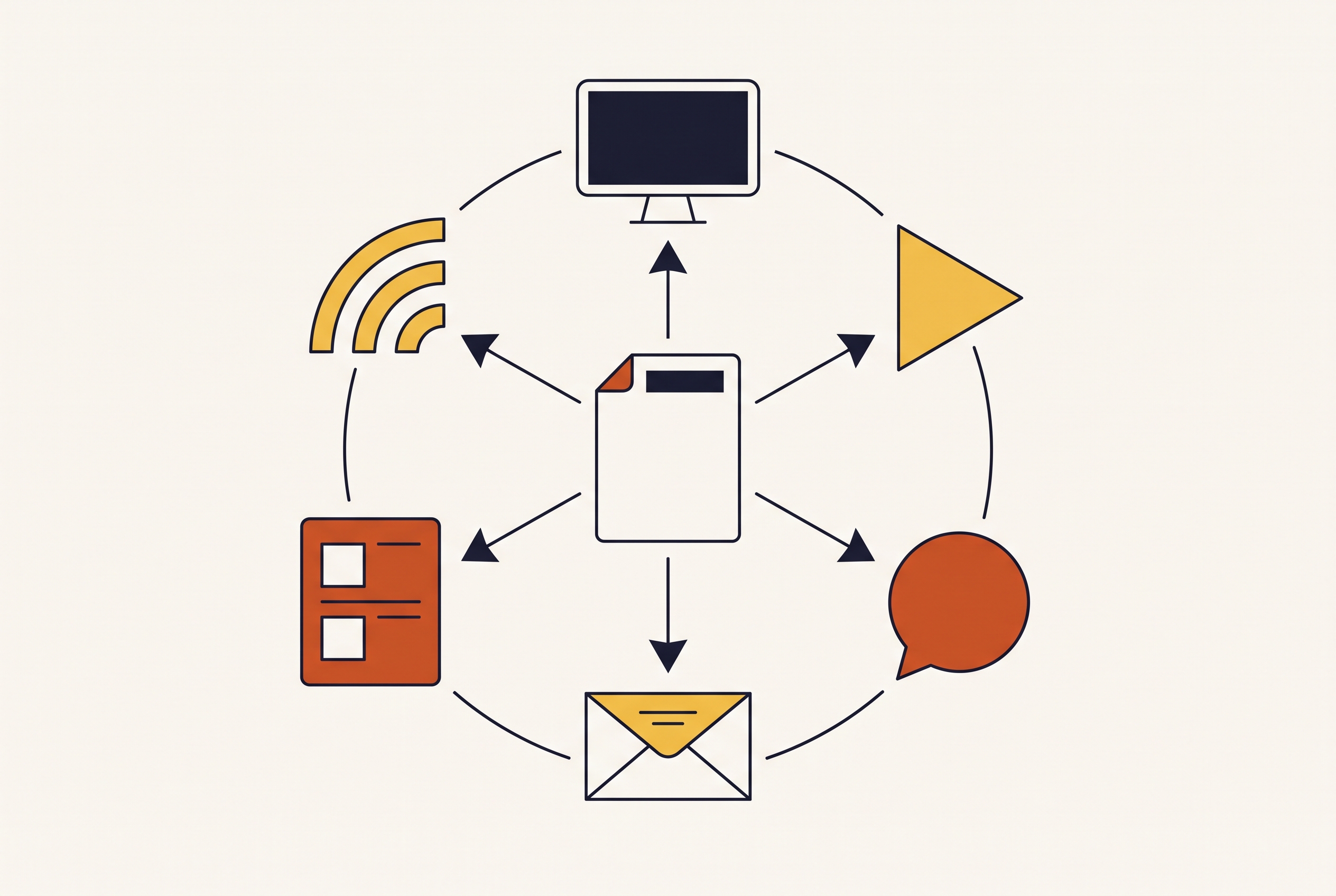
A marketing team publishes a strong piece, a founder memo or a well-researched webinar, and watches it spike for a week before it goes quiet. It is a failure of distribution: roughly sixty to seventy percent of the commercial value in a typical blog post, webinar, or founder memo gets abandoned the moment the first publish button is clicked. The team treats each channel as if it needs its own original idea, when the actual requirement is simpler and harder to execute well: the same insight, delivered in the native format each channel expects.
The pressure behind this comes from flat enterprise marketing budgets and industry tracking that puts the share of marketers actively repurposing content at only 35%. Under those conditions, making more raw content is hard to justify. Getting more use out of what already exists is the only path left that still has room to grow.
B2B and SaaS companies feel this gap more sharply than most, because the buyer's path has splintered. A prospect might find a company through search, watch a founder clip on a social feed, click through from an email, lurk in a community thread, and only then take a sales call, all before any direct contact happens. A brand that publishes well in exactly one of those places is effectively invisible across the rest of that path. The fix is a system for making one piece of content show up, in the right shape, everywhere the buyer already is.
What repurposing means, and what it does not
Repurposing means you rebuild one idea into the format each channel's audience actually expects, not post the same file in six places and hope the algorithm doesn't notice. Cross-platform content adaptation keeps the core message fixed while changing everything about the delivery: length, structure, tone, visual format, even the order in which ideas appear, so the piece feels built for the platform. If a post respects a channel's format, timing, and culture, it earns attention. A post that ignores all three reads as filler, and audiences treat it that way.
The range of what a single source idea can become is wider than most teams assume. A single webinar, broken down properly, can turn into a blog post, a LinkedIn post, an email sequence, a set of short video clips, a discussion prompt for a community like Reddit, a podcast segment, a sales enablement PDF, a carousel, a handful of FAQ snippets, and content a partner can run under their own name. The substance stays the same across all of it. The delivery changes completely, every time.
These three frameworks give the process some actual structure, so it doesn't just come down to instinct. COPE, short for Create Once, Publish Everywhere, says to build one high-value, well-researched pillar asset and let every other format flow from it, which keeps messaging consistent and cuts down on the mental overhead of inventing something new for each channel. The LEGO Model pushes the discipline earlier: design the pillar from the start so it comes apart cleanly into social posts, newsletter sections, and video scripts without losing its backbone, treating repurposing as a constraint built into the first draft. GEO, or Generative Engine Optimization, addresses a newer problem: as AI tools like Google's AI Overviews, ChatGPT, and Perplexity become some of the first places buyers look, content needs to be written for citability as much as for search ranking. Structured Q&As, clear definitions, and concise factual summaries are the formats these systems pull from, which makes them worth building into the repurposing plan from the start.
The common objection is that repurposing just means you do less work faster, trading quality for speed. The opposite is closer to true. Repurposing well means understanding what each platform's audience actually rewards and rebuilding the content to match it, which takes more editorial judgment than writing one piece and copying it elsewhere. That is why most teams, even ones that say they repurpose, don't do it with any real discipline.
Choosing the source asset that can carry six channels
Not every piece of content earns the effort it takes when you break it down and rebuild it six different ways. The right source asset carries real thinking, answers questions the audience is actually asking, and splits naturally into self-contained pieces. If you start from a thin or generic piece, you get thin, generic output in every channel it touches, no matter how carefully you reformat it downstream.
Strong pillar material tends to come from a specific set of formats: in-depth blog posts, recorded webinars or presentations, detailed guides and tutorials, original research or case studies, and long-form video. Picking the right one from an existing library starts with an honest audit. Which pieces got the most attention? Which ones answered a question the audience kept asking? Which ones carried a point of view nobody else in the space was making? A spreadsheet tracking past content, its performance, and its potential for reuse turns that audit into an actual roadmap.
The LEGO principle applies just as much at this selection stage as it does at the creation stage. A strong pillar breaks apart into distinct sub-arguments, specific examples, data points, step-by-step sequences, and quotable lines that each stand on their own. If a piece resists that kind of breakdown, if every section depends entirely on the ones before it with nothing that stands alone, it was never a strong pillar candidate to begin with.
HubSpot's approach to this shows what the method looks like in practice. The company built a full guide to Instagram marketing as a pillar page, then linked it to narrower cluster pieces like "How to Use Instagram Stories" and a guide to building a following, letting a reader move between the broad overview and the specific subtopic they actually came for. The pillar had enough real material in it to support genuine cluster content, so the structure works: distinct pieces with their own reason to exist, not five versions of the same paragraph with different headlines.
Google's search algorithm has started enforcing this same standard directly. After the core update that began rolling out June 30, 2025, sites built on thin or disconnected content saw their rankings fall, while sites showing real topical authority and strong expertise, experience, authoritativeness, and trust signals tended to hold or gain ground. A weak pillar fails twice: once when it produces weak derivative content across every channel, and again when it fails to rank in search.
For a team without the resources to run six channels at once, the practical move is to pick one high-substance source asset, break it into clear idea units, and publish across three to five channels before trying for all six. If the pillar isn't strong enough to support it, attempting the full six-channel spread is where most repurposing efforts stall before they get any traction.
B2B and SaaS companies feel this gap more sharply than most, because the buyer's path has splintered.
Channel one, the SEO blog as the structural anchor
The blog is where repurposing has to start, for a simple reason: it's the only channel a company fully owns. The data belongs to the team, the content has the longest shelf life of any format in the mix, and it's the source material that AI search tools and traditional search engines draw from most directly when answering a buyer's question.
Among all the channels in a cross-channel content plan, website and blog SEO is still the top channel for return on investment. HubSpot's own experience after adopting a topic-cluster structure showed a real increase in organic traffic, and the reason the blog anchors the whole system is straightforward: the team controls how the algorithm sees the content, and keeps the audience data that every other channel eventually has to borrow from. Owned channels, specifically email, blog, and the company's own website, form the foundation that gets built before layering on higher-reach channels like social platforms or niche professional networks. Building the sequence backward, starting with social and treating the blog as an afterthought, leaves a team with no durable place to send a reader back to once the social post has scrolled past.
The cluster structure gives this foundation its shape. A pillar page covers a topic at its broadest, and each downstream piece, a blog post drawn from one webinar segment, a how-to article expanding a single section of the pillar, becomes a cluster page that links back to it. Every new cluster post reinforces the pillar's authority on the topic.
GEO adaptation matters most at this layer, because this is the content AI tools actually read and extract from. Structuring the pillar and its cluster posts with clear Q&A sections, tight definitions, factual summaries, named expert opinions, and claims backed by real data makes it far more likely that the content gets pulled into an AI Overview or a generative search response. That matters even when the searcher never clicks through: a well-structured answer that gets quoted by an AI tool still carries the brand's name and framing to a reader who never visits the site.
Channel two, email as the direct-access layer for people who already trust you
Email asks something different of the pillar content than the blog does, because the person reading an email has already opted in. They are checking a message from a sender they already recognize, and they expect something that reads like a direct note. Repurposing for email means restructuring the pillar around that existing relationship, not around what a search engine is looking for.
A single pillar post or webinar can be broken into a multi-part email sequence, with each message covering one sub-argument or one cluster topic and linking back to the fuller piece on the blog. That structure stretches the life of the original asset across several separate touch points, days or weeks apart, and it doesn't require a single new idea. One well-built blog post, broken down correctly, can carry an entire five-part educational email series. The real craft is in the breakdown: each email has to work as a complete, useful message on its own, while the five together carry the subscriber further into the topic than any single email could.
The format shift from blog to inbox is not optional. Email readers do not read the way blog readers do: shorter paragraphs, a more direct and personal voice, one clear call to action per message, and a subject line that has to earn the open entirely on its own merits, since nothing else about the message is visible until it's clicked. If you carry over blog-length paragraphs or an SEO-driven structure into an email, the message usually gets skimmed once and ignored after that.
Email is also where repurposed content starts doing work for sales, not just marketing. If you package the ROI figures and case studies from the original pillar into material built for account executives, the kind of use the Umbrex case demonstrates, the same core content can travel directly into sales conversations.
Channel three, LinkedIn where the algorithm now rewards real editorial work
LinkedIn is the highest-leverage channel for B2B distribution, and it's also the channel that currently punishes lazy repurposing hardest. LinkedIn rolled out a feed ranking system in March 2026 that deprioritizes generic, obviously AI-assembled content, so its organic reach drops substantially. For any team used to treating LinkedIn as a place to drop a slightly shortened version of the blog post, that update is a direct signal that the old shortcut no longer works.
That's actually good news for teams willing to do the work properly. The update doesn't punish repurposed content; it punishes repurposing done without judgment, content that reads as mechanically reformatted rather than genuinely adapted for the platform's audience and culture. A pillar post rebuilt thoughtfully for LinkedIn, with real editorial attention to what the platform's readers respond to, is exactly the kind of content the new system is built to reward.
Format choice on LinkedIn carries real weight here. Carousels consistently earn stronger engagement than either video or static images, because you control the pace, swiping through each point at your own speed. A pillar post's core arguments translate naturally into a carousel's slide-by-slide structure, each slide carrying one sub-point the way each email in a sequence carries one.
Video is the second viable format for the platform. LinkedIn video viewership grew 36% year-over-year according to recent channel data, so short explainer clips drawn from a webinar segment are a legitimate second option alongside the carousel, not a replacement for it.
What ties both formats together is the writing around them. LinkedIn audiences respond to captions that read as professional and story-driven, and that copy has to be written specifically for this platform's voice. If you carry over the blog's SEO-driven phrasing, or the email's direct personal tone, without rewriting it for LinkedIn's particular register, you hit the exact failure mode the March 2026 update was built to catch.