
Essay Content Strategy
Keyword Research for Startup Blogs in Competitive Niches
Startups need long-tail keywords and niche positioning to compete against entrenched rivals.
A Series A startup chasing "project management software" and HubSpot chasing the same term are not playing the same game, even though the keyword research tools treat them as if they were. This piece argues that startups in competitive niches need a deliberately asymmetric approach to keyword research, built on long-tail specificity, intent filtering, and topical depth, because the standard playbook was built for sites that already have what a startup doesn't have yet.
Startups can't win keyword research by copying established players
A startup with six months of content and a handful of backlinks is competing, on paper, for the exact same search terms as a company with a decade of domain history and thousands of referring domains. The standard keyword research playbook, seed a list of terms, sort by monthly search volume, go after the biggest numbers, assumes the site doing the research has some baseline authority to spend. That assumption holds for a company at HubSpot's scale. It does not hold for a Series A startup trying to compete against HubSpot for the same head terms, because the playbook was never built with a zero-authority domain in mind.
The disadvantage here is structural. A new site has no backlink profile, no content history, and none of the accumulated domain authority that search engines use, in part, to decide which pages deserve to rank on page one. Those are the same inputs that keyword difficulty scores are built from, so a startup reading a difficulty score is really reading a measure of how strong the current leaderboard is. High-volume head terms are occupied by sites that have spent years accumulating that strength, and a startup that spends months producing content aimed at those terms will likely produce pages that never reach page one.
The gap also widens with time. Domain authority compounds: the longer a startup delays building a strategy suited to its actual position, the further behind it falls relative to competitors who are still publishing, still earning links, still strengthening the exact metrics the startup is missing. A page that never surfaces on page one produces no exposure, because visibility is the precondition for brand awareness rather than a side effect that happens regardless.
What keyword difficulty scores measure
Keyword difficulty scores look like neutral measurements of how hard a term is to rank for. They're closer to a snapshot of how strong the incumbents currently ranking happen to be. Every one of those inputs is a dimension on which a brand-new site scores close to zero. The score is really describing the competition a startup would face, not the startup's own chances of winning.
That distinction matters most in the cases that look deceptively safe. A startup reading that score as a green light is comparing itself to an average it has no way of matching yet. The practical fix is to treat the difficulty score as half the picture and add a second filter on top of it: can this domain, specifically, realistically compete for this term right now? Volume and difficulty numbers only become meaningful once that question has an honest answer.
The deeper shift is in what the question even needs to be. Keyword research used to stop at "how hard is it to rank for this." The more honest version of that question for 2026 is whether a brand can realistically become the cited source on a topic, a bar that has little to do with a tool's difficulty number and everything to do with whether the site can build real depth there. Google's AI Overviews worsen head-term rankings for everyone, not just startups: broad, short-tail searches increasingly surface an AI-generated answer directly on the results page. Even sites with strong rankings on those terms are seeing less of the organic traffic that used to come with them.
The startup's structural advantage: specificity as a keyword strategy
"Project management software" gets roughly 110,000 searches a month, and it is effectively impossible for a new site to rank for it. "Project management for remote design teams" gets around 320 searches a month, with far less competition and a searcher who is much closer to a buying decision. A startup's narrow focus, the specific problem it solves, for the specific audience it serves, in the specific context that audience operates in, generates a whole universe of search terms that large competitors have no reason to chase and often no ability to write convincingly about.
Long-tail terms aren't niche by accident. Enterprise competitors build their entire content operation around the big, broad terms with the big, broad volume. They have no structural reason to go deep on the narrow queries that describe one precise buyer's problem, and going that deep, for hundreds of narrow terms, isn't an efficient use of their resources even if they wanted to.
Specificity also happens to be exactly where AI Overviews run out of room. A generic, short-tail query gets summarized in three sentences at the top of the results page, because a generic answer is easy to generate. A conversational, specific question about a niche use case is much harder to answer in three sentences, which is precisely the kind of query where a detailed, well-built page can still win the click. The startup's product focus, what it solves, for whom, under what conditions, is the foundation the rest of the keyword strategy gets built on.
A four-layer keyword research framework built for startups with no authority
Startup keyword research works best as a sequence of four layers, each building on the one before it. Most teams stop after the first layer and never find the real opportunities waiting in the other three.
The first layer is foundation: seed keywords that map out the landscape the startup is working in. This starts with a brain-dump covering the product, the problem it solves, the audience it serves, common use cases, comparison terms, and audience modifiers, aiming for somewhere around 20 to 30 seed terms before any filtering happens. From there, Google Autocomplete and the "People Also Ask" boxes help expand the list, and Google Search Console is worth checking for any queries already ranking in the lower positions on page one or two, often called "striking distance" terms, since those represent existing traffic that's close to converting into real rankings with a bit more work. This layer is a starting point.
The second layer closes the gap between a startup's current keyword list and what's actually working for other sites. That means identifying SERP competitors, the domains that show up repeatedly in search results for the target terms, which is a different list from a startup's actual business competitors. Every keyword that surfaces this way is a validated opportunity: it appears in competitors' rankings because someone has already proven there's real search demand for it.
The third layer is long-tail: specific, low-competition variations of the seed terms, built by layering in audience modifiers, use-case qualifiers, and problem descriptors. These produce the fastest wins and the most qualified traffic, provided each one is filtered against the startup's actual rankability rather than against a difficulty score alone.
The fourth layer is emerging terms: the queries competitors haven't found yet. Mining Reddit threads, niche communities, and industry forums for vocabulary that's starting to circulate, before any keyword tool records it, gives a startup a genuine first-mover advantage on language its competitors haven't noticed is gaining traction. Once all four layers are populated, the full list should get organized by topic cluster, by search intent, and by funnel stage. That organized list becomes the keyword database that drives the rest of the content calendar. Every keyword on it still has to clear three tests: business fit, rankability, and AI visibility. A term that fails those tests is a skip, no matter how large its volume is.
A page that never surfaces on page one produces no exposure, because visibility is the precondition for brand awareness rather than a side effect that happens regardless.
Filtering keywords by intent before prioritizing by volume
Search intent is what decides whether a keyword can convert at all, and for a startup that can only publish so much content in a given month, picking the wrong intent costs more than picking a slightly smaller volume number. Every keyword falls into one of four buckets: informational, where the searcher wants an answer; commercial, where they're comparing options; transactional, where they're ready to act; and navigational, where they're looking for a specific brand or site.
A lean startup team generally gets more return from putting its limited publishing capacity against commercial and transactional terms than against broad informational ones, since traffic without purchase intent behind it does little for a company that needs signups or sales, not just pageviews. That doesn't make informational keywords worthless: they support the topical clusters covered in the next section and capture demand earlier in a buyer's research process. They belong on the calendar as supporting pieces for a cluster.
A few intent categories deserve particular attention from startups specifically. Workflow and use-case keywords, tied to how a product fits into a specific task, matter a lot for SaaS and tool-category content in particular.
Some keyword types are worth avoiding regardless of how low their difficulty score looks, because AI Overviews are absorbing them directly. Every keyword, before it gets scheduled, should also pass a rankability check: does the startup's domain have a realistic path to page one for this term within the next six months? If the answer is no, the keyword goes on a future list.
Topical authority as the compounding answer to low domain authority
A single long-tail blog post, on its own, does very little for a startup's authority. The same post, built as one piece of an organized cluster around a central pillar topic, starts contributing to something that compounds: the collective topical authority of the site as a whole, which is what eventually lets a startup compete for harder terms than it could rank for on day one.
The underlying shift is in what ranking even measures now. Keyword-level SEO ranks individual pages. Topical SEO ranks whole websites. Individual keywords still matter, but mainly as the building blocks that support a site's authority on a subject, not as the entire strategy in themselves. Picture a startup in the content marketing space building a pillar page around "content marketing for SaaS startups," surrounded by cluster articles covering specific channels, specific use cases, and specific stages of company growth, each one interlinking back to the pillar and to each other. That's the architecture that turns a pile of long-tail posts into a coherent body of coverage search engines can recognize as depth on a subject.
The obvious objection to a long-tail-heavy strategy is fragmentation: dozens of thin posts answering narrow questions, each converting poorly on its own, never adding up to anything larger. That outcome is a failure of architecture. Cluster articles have to interlink to a pillar page deliberately; a long-tail post that stands alone, with no pillar to connect to, is a one-off asset that doesn't compound no matter how well it performs individually. A keyword that maps to an existing cluster deserves scheduling priority before one that doesn't. If it doesn't, it probably doesn't deserve a publishing slot yet.
Topical depth matters for AI citation as much as for traditional ranking. Google and AI-powered search tools alike reward sites that show breadth and depth across a subject area. A startup that starts building this kind of depth early creates a moat that widens the longer it keeps at it.
Prioritizing which keywords to publish first with limited resources
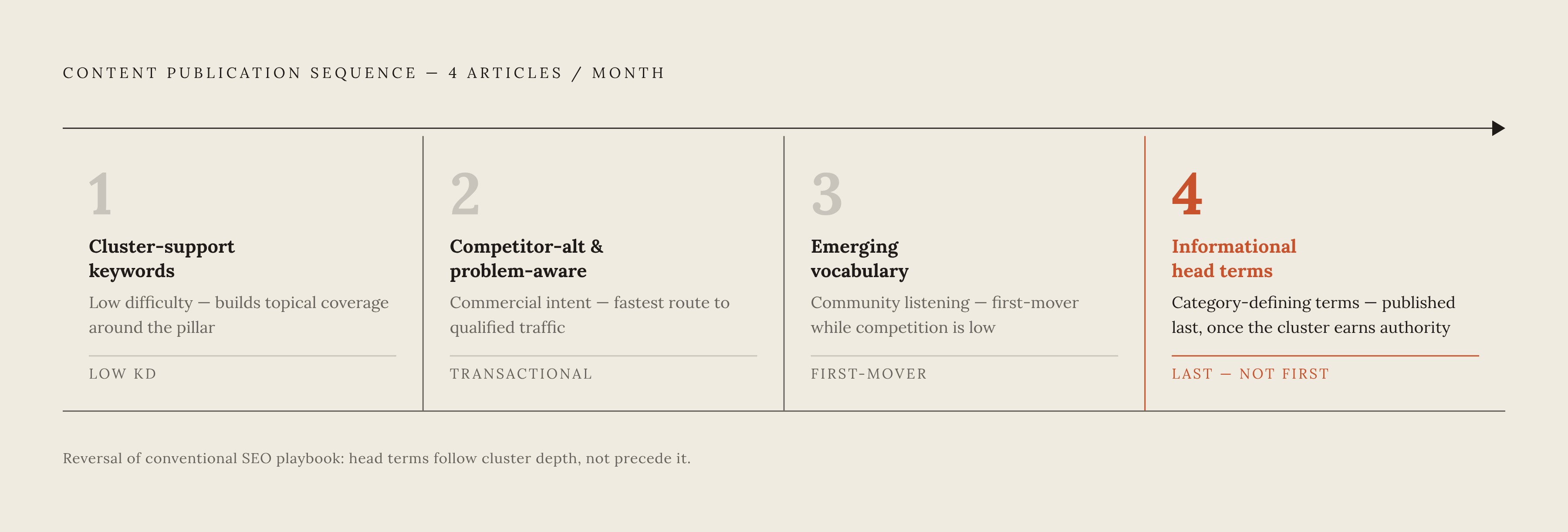
A startup that can publish four articles a month has to treat keyword prioritization as an editorial decision as much as an SEO one, and the criteria that make sense for a five-person content team look different from the criteria a large, well-resourced team would use.
Every keyword under consideration should pass four tests before it gets a slot on the calendar: business fit, whether the topic genuinely connects to the product; rankability, whether the domain can realistically compete for it right now; intent, whether it's likely to drive pipeline or signups rather than passive traffic; and AI visibility, whether a well-built page can still win the click over an AI-generated summary. A keyword that fails two or more of these tests should be skipped, regardless of how large its search volume looks on paper.
For a startup starting from zero, a reasonable sequence runs in four stages. Cluster-support keywords at low difficulty come first, since these build the topical coverage around a pillar that makes harder terms reachable later. Competitor-alternative and problem-aware keywords with commercial or transactional intent come next, since these offer the fastest route to qualified traffic that can actually convert. Emerging vocabulary terms pulled from community listening come third, offering a first-mover opportunity while competition is still low. Informational head terms that define the category come last, published once the surrounding cluster has enough coverage to give them context and internal links to lean on.
Google Search Console's "striking distance" opportunities, content currently sitting in positions 8 through 20, deserve priority treatment above nearly everything else on this list, since optimizing an existing page tends to produce results faster than publishing something new from scratch. A startup that runs this sequence consistently builds the kind of search presence that gets harder for competitors to copy with every month that passes.
Notes
- Keyword Research for Startups: Finding Opportunities Your Competitors Miss
Provided the specific search volume figures for 'project management software' and 'project management for remote design teams' cited in the article, and informed the prioritization criteria for resource-constrained startup teams.