Positioning Against a Dominant Incumbent for Startups
Startups beat incumbents by exploiting the gaps their size creates.

Startups don't beat dominant incumbents by getting better at what incumbents already do. They win by finding the exact place where an incumbent's size and structure make it unable to respond, then building a position that puts that weakness on display. Matching a well-capitalized incumbent feature-for-feature is a losing wager: by the time a startup closes the gap on any given capability, the incumbent has already moved the target twice. Fast Company's Phil Santoro has pointed out that big companies can take up to two years to move an idea from inception to market, a lag built into their size rather than a fluke of any one team. That lag is the opening this piece is about, and most startups spend their energy on the wrong side of it, chasing parity instead of finding the gap.
How incumbents' structural advantages quietly become structural weaknesses
Every advantage that makes an incumbent dominant also constrains it. That is straightforward. It's just how organizational scale behaves under pressure, and it shows up in four predictable places.
Breadth is the first, and it's the one founders underrate most. A product built to serve everyone ends up serving no one especially well, because incumbents can't build for a niche segment without diluting whatever made the core product sell in the first place. Each enterprise feature bolted on to satisfy one big account makes the product marginally harder for a smaller, more specialized buyer to pick up. That complexity never shows up on a spec sheet, but the buyer feels it during onboarding, and that feeling is the wedge.
Slowness compounds it. A small team chasing one goal moves faster simply because fewer people need to sign off before something ships, a dynamic that gives young companies a real structural edge. Incumbents see threats plenty of the time. What they can't do is reposition quickly, because procurement, internal politics, and multi-quarter planning cycles slow the response regardless of whether leadership saw it coming.
Architecture is the third weak point, and it's the one incumbents least want pointed at directly. Legacy platforms carry technical debt that limits what they can build and how fast. A startup can credibly say "this was built for the world you're operating in now, not the world of ten years ago," and an incumbent running on a decade-old data model has no comeback that doesn't sound defensive. That's not a footnote for a sales deck. That's the whole argument.
Risk tolerance rounds it out, and this is the one worth sitting with. Incumbents protect the revenue they already have, so they can't cannibalize their own product the way a startup can cannibalize an idea that hasn't shipped yet. That's a cultural constraint as much as a strategic one, and it explains why so many incumbents watch a threat approach and still do nothing for a year. Most leadership teams would call this caution. It's actually paralysis dressed up as discipline, and a challenger that's watching closely, really watching, holds an edge that has nothing to do with funding and everything to do with paying attention while the other side isn't.
Choosing where to attack: segment selection before messaging
Positioning doesn't come first. Segment does, and skipping that step is why so many differentiation efforts read like generic marketing copy. A startup can't write a position worth reading until it knows exactly who that position is for, and most write the position first anyway.
Competitive set is a choice, not a fact handed down by the market. The startups winning in crowded categories right now aren't the ones with the broadest platform. They're the ones with the tightest wedge, built around one mechanism, one buyer, and a go-to-market loop designed to prove value fast.
A viable wedge segment tends to share the same traits. The incumbent over-serves it, usually because the product is too complex, too expensive, or built for a buyer three tiers up the org chart. The segment has needs the incumbent's business model can't meet without cannibalizing itself. It's reachable, with identifiable job titles and people who actually hold buying authority. And it's large enough to build a real business on, but not so large the incumbent has bothered to prioritize it yet.
ZoomInfo's early growth against D&B is the clean version of this pattern. D&B built its business around high-value enterprise accounts; ZoomInfo went after SMBs, a segment D&B had effectively ceded, with a self-serve product priced around $5,000 a year against data packages that ran past $100,000. Apollo pushed the same logic further with a $99-per-user-per-month model and a product-led growth motion aimed squarely at buyers the incumbents had deprioritized. None of these companies out-featured the incumbent. They picked a fight where the incumbent had no motivation to show up, proved the model worked, and expanded from there. That sequence, not the pricing, is the actual lesson, and it's the part most case studies skip past to get to the numbers.
Becoming the default answer for one specific segment builds expertise a generalist competitor can't fake, supports premium pricing, and takes the buyer out of a price-comparison mindset entirely. That's where the analytical work of segment selection actually pays off, not in the messaging that comes after.
Finding the real wedge through win/loss intelligence, not assumptions
Most startups think they know why they win deals and why they lose them. Most are wrong, and the gap between the story a founder tells and what actually happened on the sales call is often the whole problem.
A case documented in the GTM Playbook makes it concrete. A 40-person B2B SaaS company was competing against a much larger project management incumbent, and its product covered the same ground: dashboards, Gantt charts, integrations, collaboration tools. Every call opened the same way. "We already have a tool that does this." None of the positioning moved a prospect who was already comfortable with what they had, because none of it gave the prospect a reason that comfort was misplaced.
Structured win/loss interviews turned up what the sales data never surfaced: engineering leads at software companies who found the incumbent's reporting too manual and its structure too rigid for agile sprint planning. That buyer had been sitting inside the company's broad ICP the whole time, invisible until someone sat down and asked won and lost customers what actually happened.
Win/loss conversations surface things a CRM report can't reach: the exact friction point that sent a buyer looking elsewhere, the specific language they use to describe the problem (language that becomes positioning copy almost word for word), which competitor made the final shortlist and what that competitor told the buyer, and the real reason deals were lost, which often turns out to be something the CRM data never captured.
Most companies skip this work entirely and guess instead, which is why so much positioning sounds like it was written in a conference room rather than pulled from an actual sales call. What comes out the other end of a real win/loss process is a precisely named buyer, a precisely named pain, and a before-and-after contrast the incumbent has no credible way to claim for itself.
Constructing a position that makes the incumbent's liability visible without triggering a feature comparison
Copying an incumbent's positioning language is a trap. It puts the comparison on their terms, and a fight over feature count or brand budget is one a startup cannot win. Skip the feature matrix entirely. It's the wrong argument, and reaching for it is the single most common mistake in this whole exercise.
The real goal is reframing the question a buyer asks in the first place: not "which tool has more features," but "which tool was actually built for what I'm dealing with." Three moves get there.
Attack complexity instead of capability. An incumbent's product can usually do whatever the startup does, technically speaking, but getting there might require weeks of configuration, a training program, or a professional services engagement. Framing that capability as a burden ("you'll need a consultant to turn this on") turns the incumbent's strength into the buyer's problem. That's a cost-of-ownership argument, not a capability argument, and the incumbent can't out-feature its way out of it.
Name a category the incumbent doesn't own. Incumbents hold the broad category name almost by definition, that's part of what makes them the incumbent. A startup can name something narrower: not "project management," but "sprint planning for engineering teams at software companies." Naming the sub-category makes the incumbent look like a generalist by comparison, without ever mentioning them by name.
Position around a mechanism, not a claim. Saying "we do X" is a claim. Saying "we do X by doing Y, which the incumbent can't replicate without rebuilding its architecture" is structural. A different data model, a different delivery method, an architecture built without a decade of legacy constraints: that kind of differentiation is much harder to copy than a feature.
Pricing carries its own signal, and it's easy to underestimate. Clear positioning supports premium pricing; ambiguous positioning forces a company into discounting just to close deals. Even the pricing model communicates who the product is for: self-serve versus field sales, per-user versus enterprise contract, usage-based versus flat rate. Each choice tells the buyer whether the product was built for them or for someone three levels above them.
Good positioning is never a list of the incumbent's weaknesses, a feature matrix, "we're like them but better," or any claim the incumbent could neutralize with a single product update next quarter. If a competitor could shut down the argument with one release note, it was never a position to begin with.
Applying this to a fast-moving category: AI visibility as a live example of incumbent liability
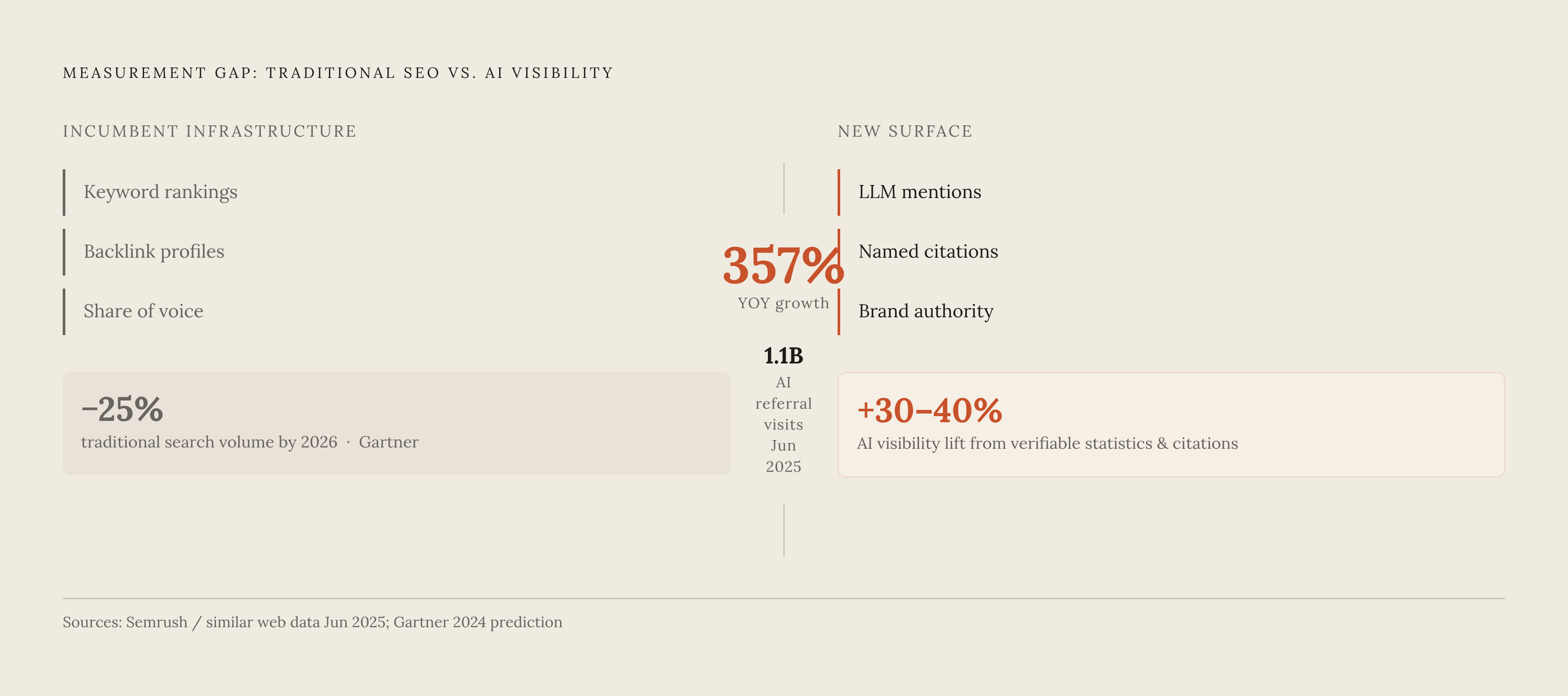
AI visibility is the clearest live case of this dynamic playing out right now, because the ground is moving faster than incumbent measurement infrastructure can follow.
Gartner predicted traditional search engine volume would fall 25% by 2026, and that prediction has already started to materialize. Similarweb's 2025 Generative AI report found AI chatbot referral traffic grew 357% year over year, reaching 1.1 billion referral visits in June 2025 alone. That's not a slow drift. That's a category rewriting its own rules while the incumbents are still in the meeting about it.
Traditional SEO platforms were built to track keyword rankings and backlink profiles. That infrastructure has no native way to track whether a brand gets mentioned inside an LLM-generated answer, because the thing being measured didn't exist when the platform was designed. Adding that capability isn't a feature update. It requires rebuilding how the platform defines "visibility" in the first place, and most incumbents resist that because it would expose how much of their existing metric set has quietly gone stale.
That lag creates a rare kind of leveling. GEO (generative engine optimization) runs roughly 80% strategic, positioning, ecosystem presence, brand authority, and only about 20% technical, which means dominance here isn't purely a function of ad spend or engineering headcount. Profound's AI visibility data from June 2025 showed smaller brands like Navy Federal Credit Union and Upstart achieving disproportionate representation in LLM-generated answers, landing in consumer consideration sets that traditional share-of-voice metrics would never have predicted. Content built around verifiable statistics and named citations achieved 30 to 40% higher AI visibility than unoptimized content, according to Princeton research on generative engine optimization, a tactic that costs effort, not budget.
The opening is for more than just brands. It's for the agencies that serve them, and most of those agencies are still answering client questions about AI visibility with a shrug. An agency that has built real AI visibility capability, and trained its account teams to talk about it credibly, can position against larger agency incumbents with exactly this framework: not "we offer more services," but "we were built for the world your buyers are already living in." Thrad's work building advertising infrastructure for paid, native ads inside LLM conversations and AI chat applications is a useful illustration: purpose-built infrastructure for a new surface makes a general-purpose competitor's offering look like a mismatch for the moment, without anyone needing to say so out loud.
Protecting the position: why a wedge collapses without ongoing intelligence
A wedge that works doesn't stay unnoticed for long. Incumbents eventually respond, usually by acquiring the threat, copying the core feature, or partnering their way into the gap. A startup that treats its early win as permanent is building its own blind spot: the same one that just cost the incumbent the deal.
Speed doesn't expire on its own, but it has to keep getting used. If a startup's decision cycles start slowing as headcount grows, the speed advantage it started with disappears quietly, replaced by the same procurement drag and internal politics that made the incumbent slow in the first place. Getting product in front of customers fast, deciding quickly whether to double down or pivot, staying lighter on internal politics than the incumbent: none of that is a launch-phase tactic. It's an ongoing discipline, and Fast Company's reporting on startup speed treats it that way.
Competitive intelligence has to stay continuous for the same reason. Tracking win/loss patterns, running customer advisory boards, watching competitor pricing and release notes: that's a habit, not a one-time audit, and a startup that lets it lapse loses the exact visibility that won the first few deals.
Segment drift is the quieter risk, and it's the one that kills wedges from the inside. Growth tempts every company to widen its ICP to capture more of the market, and that's exactly the process by which today's challenger turns into tomorrow's bloated generalist, the same shape it originally set out to beat. Expanding too early dilutes the specialization that built the moat. Sequoia Capital's 2025 investment criteria explicitly call out "defensible differentiation," which says something about how closely investors now watch whether a wedge survives its own growth.
Positioning is a living document, not a launch asset. Markets shift, the language buyers use to describe their problems shifts with them, and a claim that sounded sharp eighteen months ago can curdle into something generic without anyone noticing, until a prospect says "we already have a tool that does this." Regular win/loss reviews and messaging audits are what catch that decay before it costs a deal. Watching competitors closely, continuously, is mandatory for anyone serious about holding ground they've already won. It's the only thing standing between a wedge and the slow drift back into looking exactly like the incumbent it replaced.