Email Subject Line Copy for B2B Cold Outreach
Earn replies by ditching cleverness for brevity, specificity, and genuine triggers.
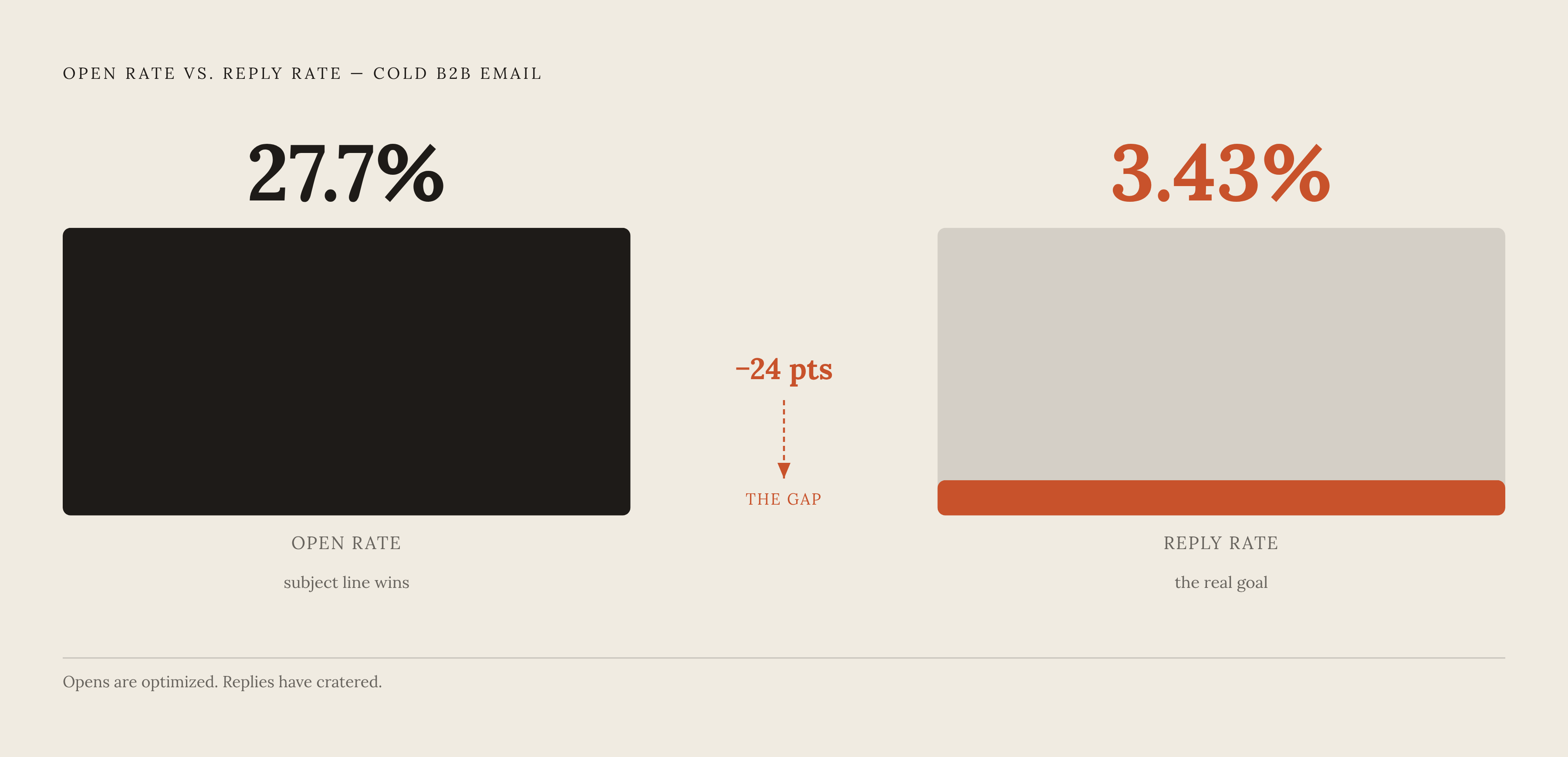
Reply rates for cold B2B email have fallen substantially, from a figure Instantly's benchmark data placed in the low single digits down to 3.43% today. Open rates, meanwhile, are a seemingly healthy 27.7%. That gap is the entire story: subject lines are getting judged on the wrong metric, and the fix is not cleverness, it's brevity, specificity, and relevance tied to something real about the recipient. This piece breaks down what actually earns a reply, not just a glance.
What the inbox looks like from a recipient's perspective in 2026
Over 60% of B2B email now gets opened first on a phone, where the subject line truncates around 30 to 40 characters. Whatever hook a sender wants to land has to land before that cutoff, full stop. There's no second chance for a clause that gets chopped off mid-thought.
Before a human even sees the message, Gmail and Outlook's filters are already scanning for salesy signals: ALL CAPS, buzzword density, structural patterns that resemble known spam templates. Craft a brilliant subject line and it still won't matter if the filter routes it to a folder nobody checks.
The phrases that used to signal a human wrote this email, "quick question," "thought this might be useful," have been used so heavily by AI-assisted sequencing tools that they now signal the opposite, which is the twist tripping up a lot of outreach teams right now. Woodpecker's analysis flags both as automation tells. The very phrases built to sound casual and personal have been worn smooth by scale.
Recipients make their open-or-delete decision in only a few seconds. A vague line dies in that window every time. The same conditions that make personalization necessary (AI filters, inbox saturation, mobile truncation) also make fake personalization instantly obvious. A first-name merge field isn't research. Recipients can tell the difference, and the bar for "genuine" keeps rising as the fakes get more common.
The three mechanics that earn an open: brevity, specificity, and signal-led relevance
Three things move the needle. Not eleven, not a checklist of "best practices," three mechanical levers that interact with each other.
Brevity comes first, and the data on it is fairly blunt. Lavender's email analysis from 2024 through 2026 shows subject lines under seven words outperforming longer ones, with question-based lines pulling 10 to 15% higher open rates than flat statements. Lines of one to three words get the single highest open rates, but three to seven words is where most cold outreach should live: short enough to register instantly, long enough to carry a shred of context. Tomba.io's comparison is useful here: a driver doing 70 miles an hour reads about six words on a billboard. A commuter scrolling email on a train gives a subject line roughly the same window. A twelve-word subject line is a billboard with a paragraph crammed onto it, and nobody's slowing down to read it. Short lines also just look like internal email, not marketing copy, and that visual cue registers before a single word gets parsed.
Specificity is the second lever, and it's the one most cold email gets wrong by trying too hard to sound clever instead of sounding real. Gong's analysis of a large cold email dataset (cited in Martal's 2026 report) found that subject lines reading as "salesy" cut open rates by as much as 17.9%, and pitching anything in the subject line undermines the credibility that specificity is meant to build. The fix isn't mystery, it's specificity: naming a company, naming a role-specific problem, referencing something that actually happened recently. "Question about [Company]'s outbound" beats "Quick question" not because it's more intriguing. It beats it because it's more believable. Numbers in subject lines are a genuine open question here: Woodpecker's data shows a real open-rate lift from including numbers, while Gong advises against them in cold sales contexts specifically. Neither side has definitively won that argument, and treating it as settled either way would be false confidence. Test it on your own list.
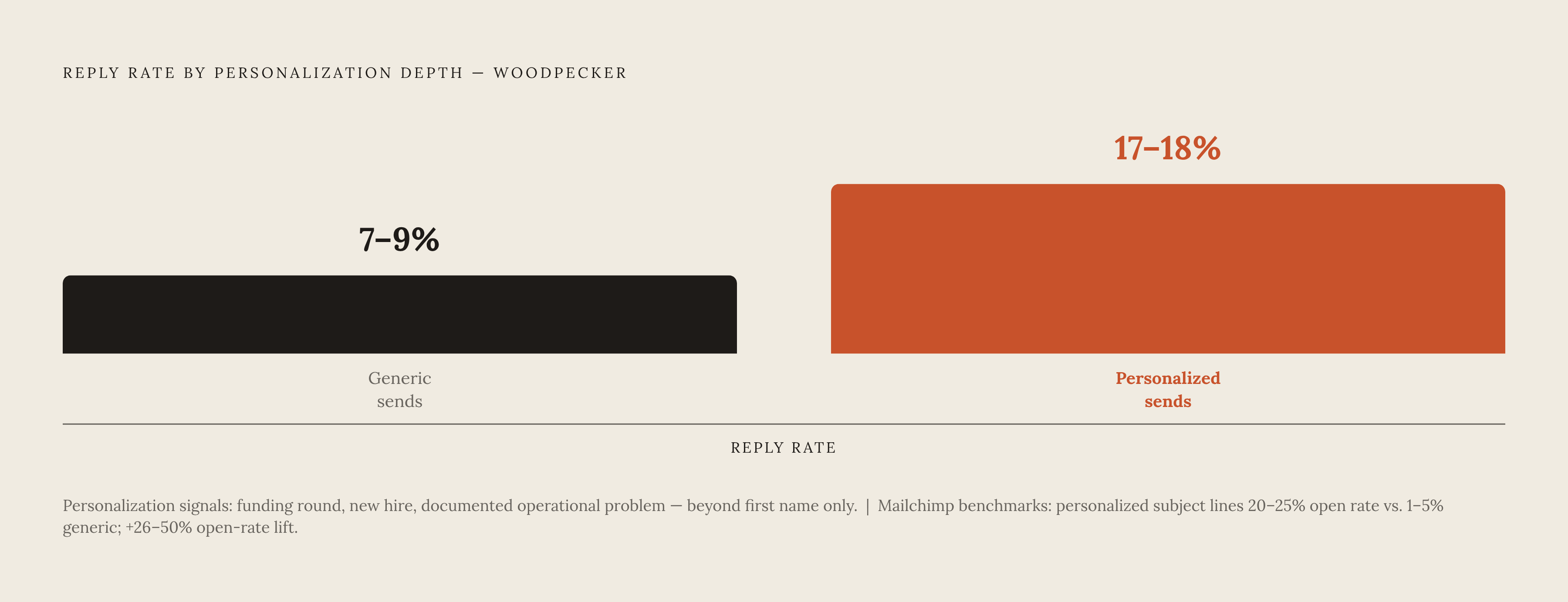
Signal-led relevance is the third, and probably the one most commonly faked. Personalization that goes beyond a first name (a funding round, a new hire, a documented operational problem) roughly doubles reply rates against generic sends, per Woodpecker's data: 17 to 18% versus 7 to 9%. Personalized subject lines overall see 26 to 50% higher open rates than generic ones. The mechanism is simple: a trigger event gives the recipient a logical reason for contact right now, rather than a mass blast that happens to land in their inbox because a quota cycle demanded volume. "Congrats on the Series B" is time-bound and actionable. "Hope you're doing well" is noise, and recipients have learned to file it as such.
None of these three operate independently. A short line with no specificity is just a shrug. A specific line that runs to fourteen words is a paragraph nobody reads. The target is all three at once, and optimizing one at the expense of the others degrades the whole thing.
Personalization tiers: how to calibrate research depth to list size and account value
Research depth should scale with account value, not stay fixed across a whole list. Tomba.io's three-tier framework is a useful way to think about where the effort actually belongs.
Tier one covers high-value accounts, where manual research pays for itself: a specific trigger like a new executive hire, a product launch, or a funding round, referenced directly in the subject line. Reach out within roughly two weeks of the trigger, because the context is still live and the recipient still remembers it happened. Reach out within roughly two weeks of the trigger, while the context is still live and the recipient still remembers it happened.
Tier two is segmented lists, where templated subject lines carry one verified merge field, company name, industry, or a specific role. One accurate token beats five approximate ones, and that's not a stylistic preference, it's a trust mechanism: a wrong detail is worse than no detail.
Tier three is broad outbound, formula-based lines with a single dynamic token, tested at volume. At this scale, deliverability and list hygiene matter more than any wording choice, so hours spent polishing copy further will not fix the underlying problem.
Persona matters as much as tier. Cleanlist.ai's analysis notes that a VP of Sales responds to different signals than an individual contributor on the same team, so role-appropriate vocabulary is itself a form of research, not just tone-matching.
The failure mode is predictable and common: applying tier-one language, "Congrats on your funding round," across 500 prospects when two of them actually raised money. A fake trigger is worse than no trigger, because it proves the sender didn't check. Mailchimp benchmark data puts personalized B2B subject lines at 20 to 25% open rates on average, against 1 to 5% for non-personalized campaigns. That gap is not about clever phrasing. It's almost always about whether the merge field data was actually correct before the send went out.
Proven subject line formulas with the mechanic behind each one
Formulas are only as good as the real data filling the blanks. Below, organized by category, with the mechanic behind each explained rather than just the pattern handed over.
Direct and specific, best suited to senior buyers: "Question about [Company]'s outbound" leads with credibility, naming a function rather than pitching a product. "[Company] + [Your Company]?" frames a partnership, and it only works when there's actual logical overlap between the two businesses. "[Specific outcome] for [Company]" puts the result before the ask, and the number has to be real and attributable, not aspirational. "[First Name], saw you're hiring SDRs" uses a hiring signal as a proxy for scaling intent, tied to whatever pain the sender's product addresses.
Trigger-based lines lean hardest on timing. "Congrats on the [Series B], [First Name]" only works while the announcement is still recent and the context is still live. "Saw [Company] just launched [product]" needs to reference something that actually happened, not a vague nod at "growth." "Your post about [topic] got me thinking" requires referencing a specific takeaway, not just proof that someone skimmed a professional social network's feed. "Just saw the [Role] opening at [Company]" treats a job posting as an intent signal worth acting on.
Pain-focused formulas work best in the middle of the funnel. "Struggling with outbound at [Company]?" only lands when the pain is visible from outside, through job postings or tech stack signals, something the sender could plausibly have noticed. "Still using [competitor] at [Company]?" is a competitive trigger, reserved for cases where there's actual evidence they're evaluating alternatives. "The outbound problem most [industry] teams have" is trend framing, and it needs data or a case study behind it or it reads as filler.
Curiosity-driven lines suit cold lists with no prior signal, but they're risky. "Probably not for you, but…" works as a pattern interrupt precisely because it lowers pressure, though overuse turns it into exactly the cliché it was meant to avoid. "Interesting finding about [Company]" only works if there's a genuine finding behind it. A curiosity gap that doesn't pay off in the body burns trust permanently, and that recipient is gone for good.
Social proof and case study formulas borrow credibility from a peer. "How [Similar Company] added [result]" only works if the named company is one the recipient would actually recognize. "[Competitor] → [Your Company]: what changed" A real transition story has to be behind it, not implication.
Ultra-short, one-word lines: "Outbound?" "Pipeline." "Thursday?" These function purely as pattern interrupts. Zero context produces zero qualified opens, so they belong in re-engagement sequences or exhausted lists, not as a default.
Across every category, the template is never the differentiator. The input quality is.
Patterns that actively hurt deliverability or destroy trust on open
Some tactics don't just underperform, they actively damage the sender's ability to reach any inbox going forward.
Faking a reply thread with "RE:" to manufacture false familiarity is one of the fastest ways to wreck domain reputation. Once that reputation drops, even a genuinely well-written subject line lands in junk, because the problem has moved past the copy.
Spam-trigger vocabulary, "free," "guarantee," "act now," "URGENT," still trips filters before any human ever sees the line. Emojis, ALL CAPS, and excessive punctuation read as unprofessional in cold B2B outreach and trigger spam filters on top of that.
A curiosity gap that promises insight and delivers a pitch breaks the implicit contract with the reader the moment the email is opened. Whatever the subject line opens, the body has to close, or the relationship ends there. Generic openers like "quick question" and "thought this might be useful" have become automation tells, per Woodpecker's data cited in Martal's report, because they've been used by so many sequencing tools that recipients now pattern-match them to spam.
Over-promising rounds out the list: "Increase revenue by 300%, guaranteed" combines spam phrasing with an unverifiable claim, and the result is high delete rates even on the rare occasion it clears the filter. None of this is a matter of taste. Each one carries a measurable deliverability cost, separate from whatever a human recipient thinks of it.
Diagnosing deliverability and list quality before the subject line
A 2% open rate after several thousand sends is almost never a copy problem. That pattern appears repeatedly across practitioner communities and Reddit threads, per Martal's analysis, and it almost always traces back to domain reputation or list hygiene, not wording.
Diagnose in order: deliverability first, list quality second, subject line third. Most teams run that sequence backward, rewriting headlines for weeks while the actual issue sits upstream. Instantly's Benchmark Report is direct: a very low reply rate almost always points at list quality or deliverability, not copy, and no amount of A/B testing headlines will fix that.
Some infrastructure basics protect whatever subject line work does get done. Cap sending at 35 to 40 emails per day per address to protect deliverability. Follow-up cadence matters too: a well-spaced sequence of touches over the first two weeks generally outperforms a single send. Send timing matters as well, with mid-week sends during business hours widely regarded as performing better than weekend-adjacent days.
A burned domain or an unverified list will sink any subject line, no exceptions. Every delivery failure and every spam report erodes sender reputation a little further, and that erosion reduces inbox placement for every future send, not just the one that triggered it. Get the plumbing right before touching the copy again.
Running a subject line test that produces a decision, not just data
Isolate the subject line. Keep sender, body copy, send time, and segment identical across variants, per Leadfeeder's guidance, so any difference in performance can actually be attributed to the headline and nothing else. Skip this step and the test measures noise, not signal.
Segment before testing, not after. A subject line that performs well with VPs often falls flat with individual contributors on the same list, so test within a consistent persona and buyer stage rather than across mixed groups.
Measure replies and meetings first, opens second. An open-rate lift with no movement in replies is a red herring, not a win, and treating it as one is how teams end up optimizing for a number that doesn't pay the bills.
Kill losing variants weekly. Teams that run a fixed weekly decision cycle accumulate learning faster than teams stretching out extended tests before making a call. Match the test method to list size: fixed-window tests for large lists, rolling tests for smaller samples where a fixed window would take too long to reach significance.
Build a swipe file, tagged by persona, trigger type, and industry. Patterns emerge across segments that stay invisible when each subject line gets evaluated on its own. And when a test comes back inconclusive, check the environment before blaming the copy: low list quality, domain issues, or mixed segments all produce noisy results that no subject line, however well written, can be judged against fairly.
AI now handles a large share of the research and sequencing work for top-performing cold email teams, close to 80% by Instantly's 2026 benchmark data. But AI-generated personalization still needs a human to verify the trigger data before it goes out. The output is only as good as the input, and that hasn't changed no matter how much of the process gets automated.