Messaging Consistency Across Sales Deck and Website for Startups
Inconsistent messaging costs deals before prospects even evaluate your product.
Sixty-nine percent of B2B buyers, according to Gartner, have caught a supplier's website saying one thing while its salespeople say another. That's a substantial figure, not a rounding error. It's a structural failure in how startups build and manage the language that represents them, and it costs deals long before anyone notices a weak product or a soft pitch.
The pattern is familiar enough to be almost boring. The website leads with "simple." The deck leads with "powerful." The follow-up email calls the same product "innovative." Read individually, none of these words is wrong. Read together, they describe three different companies, and the prospect knows it even when they can't say why the pitch felt off.
What a messaging architecture actually is, and why startups conflate it with copywriting
Positioning and messaging get treated as the same thing at most early-stage companies. That conflation is the root of the problem, not a minor imprecision. Positioning is the internal decision: where the company competes, and on what basis it claims to be different. Messaging is what gets said out loud about that decision. A startup can have sharp positioning and still botch the messaging, or worse, skip positioning entirely and let messaging get invented fresh by whoever's writing the next slide. Most startups skip the decision and jump straight to the words. That's exactly backwards, and it's the single most common mistake in this whole process.
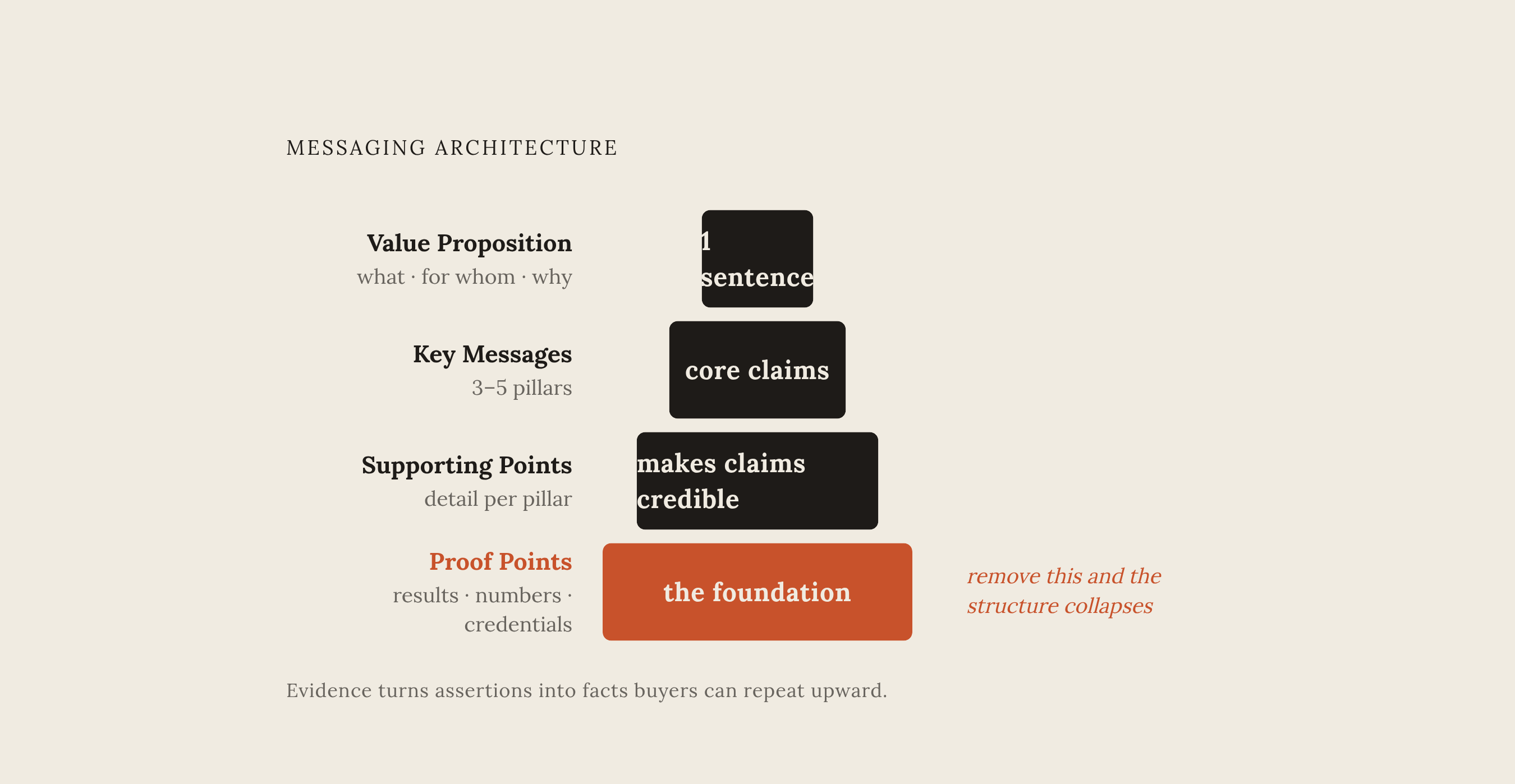
The framework that fixes this, per Metabrand's guidance for startups, works like a pyramid. At the top sits one sentence: the value proposition, stating what the company does, for whom, and why any of it matters. Below that sit three to five key messages, the pillars that back up the top-line claim. Beneath each pillar sit supporting points, the detail that makes the pillar credible. At the base sit proof points: customer results, hard numbers, credentials, the evidence that turns an assertion into a fact a buyer can repeat to their own boss.
This carries real weight beyond a tagline. It is a set of standards that keeps getting ignored after the rebrand kickoff, left to sit unopened in a shared drive. It's the documented system every piece of outward communication draws from. A complete version, per Metabrand's 2026 guide for startups, also includes messaging broken out by audience (a technical buyer needs different proof than a business buyer), a defined tone of voice, prepared answers to common objections, and boilerplate copy that doesn't change every time someone new writes the "About" page.
Look at how the sharpest companies compress this into one line. Stripe: financial infrastructure for the internet. Notion: one workspace. Every team. Linear: the purpose-built tool for planning and building products. Superhuman: built around radical speed for email. Each names a specific outcome. None hedges with "innovative" or "next-generation," because those words describe nothing a competitor couldn't also claim. Any startup still leaning on that vocabulary hasn't done the positioning work yet, full stop.
The reason this matters specifically for startups, not just messaging purists, is onboarding. Deann Sonoda, VP of marketing and communications at Blumberg Capital, has framed this document as the fastest way to get a new sales rep or a new marketing hire describing the company the same way everyone else already does. Without it, every new hire invents their own version of the pitch, and the drift Gartner measured in buyer-reported inconsistencies can begin as soon as a new hire starts improvising the pitch.
The architecture is the source. The website and the deck are expressions of it, not the thing itself. Treat either one as the origin of the message, and the drift gets baked in from the start.
How the website and the deck serve different jobs from the same raw material
The website's job is to work without a human in the room. It has to carry the value proposition and the key messages to a visitor who may never talk to a salesperson, who is comparing four other vendors in adjacent tabs, and who has no one there to clarify an ambiguous claim. Blumberg Capital's guidance is blunt about sequencing: foundational messaging has to exist before the website goes live, before a press mention runs, before a single prospect conversation happens. The website doesn't generate the message. It carries one that already exists, or it shouldn't be live yet.
The deck's job is different, and it should be. Per the Vibe.us 2026 guide to sales decks, a deck is meant to be dynamic and conversation-driven, adapting in real time to whichever decision-maker is sitting across the table. A deck is a conversation starter, not a script to be read verbatim.
That gives a startup real room to adapt, along three legitimate lines. Depth is one: a deck can go further into proof points and objection-handling than a homepage ever should, because a homepage that tries to answer every objection turns into a wall of text nobody reads. Audience lens is another: the same deck might foreground technical differentiation for an engineering buyer and swing toward ROI math for a CFO, while the website speaks to a broader, earlier-stage visitor who hasn't been sorted into either camp yet. Tone is the third: a live presentation can run warmer and more conversational than a webpage, which needs to be precise and skimmable because nobody reads a homepage the way they listen to a person.
None of that is drift. Drift starts the moment the deck introduces a claim, a differentiator, or a category label that doesn't appear on the website, or that flatly contradicts it. If the homepage sells innovation, the deck's job is to prove that innovation, with a specific feature, a specific patent, a specific technical approach. That's not the moment to pivot to price or simplicity because the argument happens to land better in the room. A prospect who watched the company call itself the innovative option online and then pitch itself as the cheap, easy option in person isn't hearing a nuanced adaptation. They're hearing the exact inconsistency Gartner's number describes.
Format is a separate lever from message, and the two get confused constantly. Storydoc's 2024 analysis of more than 100,000 presentations found visual-first decks converting up to 18% more often than text-heavy ones. But a beautifully designed ten-slide deck still fails if slide four contradicts the homepage, and no amount of design work fixes a contradiction. Blumberg Capital's own deck checklist makes this concrete at the slide level: headlines should state the takeaway, not repeat a generic label like "Our Team," and that takeaway needs to echo the website's key messages rather than invent a new framing on the spot.
Building the single source of truth startups can actually maintain
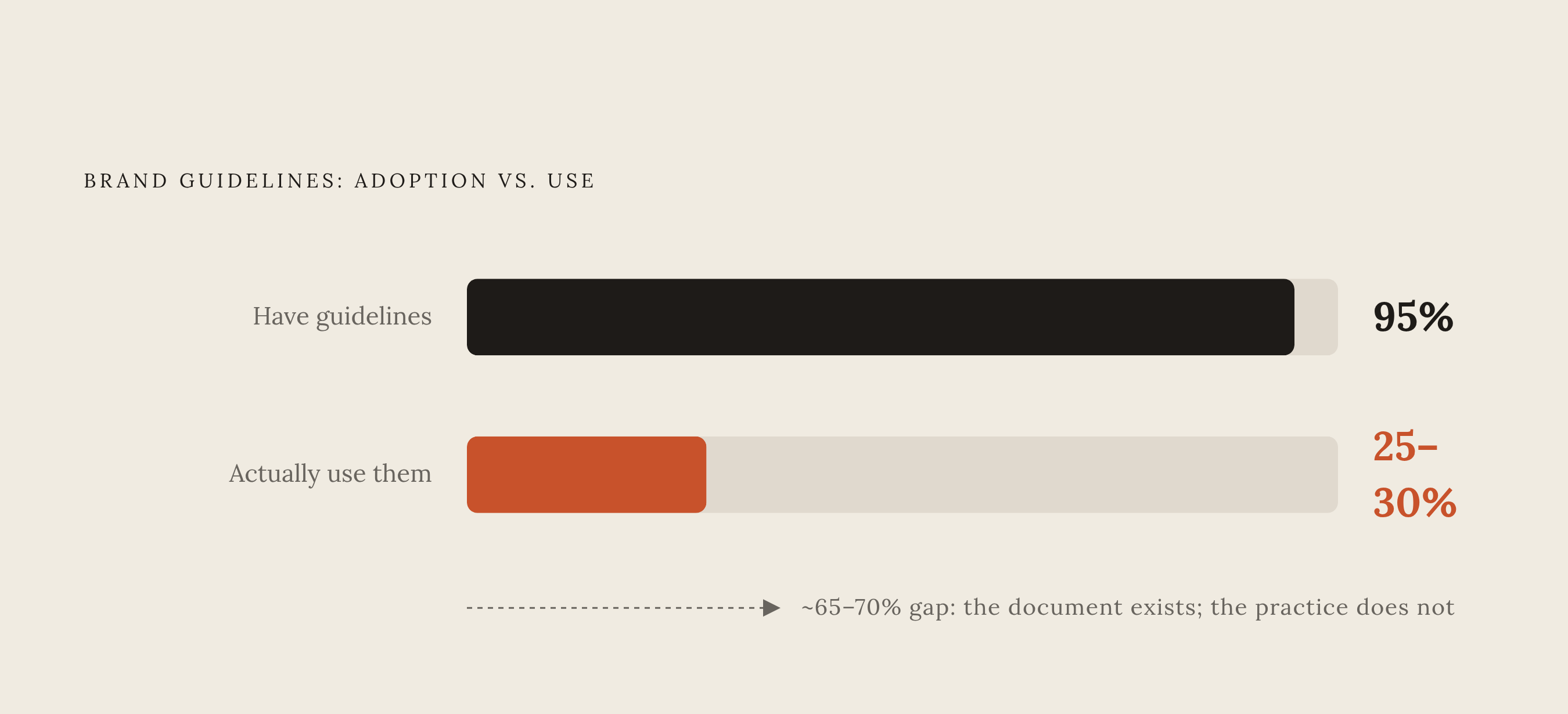
Nearly every company has brand guidelines. Estimates put the share of companies that have brand guidelines at roughly 95%. What almost none of them have is active use of those guidelines across the organization, with usage rates in the 25 to 30% range. That gap is the real story, a structural failure rather than a creative one. It's an operational one. A document nobody opens does exactly as much good as no document at all, and a startup that mistakes "we wrote it down once" for "we use it" is fooling itself.
The fix is treating the messaging architecture as a living wiki, not a file. Tools like Notion or Coda get cited specifically because they're built for structured, version-controlled, easily searched content, in contrast to a PDF that ages out of date the week it's finalized, or a Google Doc buried under six months of unresolved comments. A PDF is where messaging goes to die quietly.
Inside that wiki, the practical unit that makes it usable day to day is the message block: a pre-approved paragraph or sentence for a recurring situation, such as the company description, the one-line product explanation, or the founder bio that gets pasted into a dozen different contexts. Message blocks let a team member assemble something on-brand in minutes instead of writing from a blank page. They cut down on the improvisation that happens in sales, where a rep adapting language for one prospect today and a different prospect tomorrow is exactly how drift accumulates unnoticed.
The same source of truth can hold multiple audience lenses at once (technical buyer language, business buyer language, investor language) without those lenses contradicting each other, because all of them ladder back up to the same value proposition and the same key messages. That's the whole point of the pyramid structure: the branches can look different, but they share a trunk.
Data does more consistency work here than clever phrasing ever will. Sonoda's point is that numbers communicate fast and carry their own credibility: market size in dollars, customer impact measured in time or cost saved, a technology difference described in plain qualitative terms like faster or easier. When the website and the deck cite identical proof points, the alignment becomes self-reinforcing. Nobody has to remember to stay consistent. The number does it for them.
The cost of skipping this work isn't abstract. Reported figures suggest marketing leaders spend roughly a fifth of their time correcting off-brand materials after the fact, and brand consistency failures are estimated to run into the millions annually in wasted effort and lost trust. A brand-management vendor's research (a 2016 study with Demand Metric, updated in 2019) put the revenue lift from consistent brand presentation at 23 to 33% across channels. That range is the business case for doing this work. It isn't a nice-to-have.
Why AI systems now read messaging consistency as a trust signal, and what that means for startups
Two disciplines have emerged to describe how brands show up in answers produced by AI systems. GEO, Generative Engine Optimization, is the practice of structuring content and digital presence so systems like ChatGPT, Perplexity, and Google Gemini cite or recommend a company in their responses. AEO, Answer Engine Optimization, is the narrower discipline of becoming the direct source cited when someone asks an AI system a specific question.
The scale of this shift is no longer speculative. Gartner projected that traditional search volume would fall 25% by 2026, and and the broader pattern of AI displacing traditional search has accelerated since. Ahrefs, analyzing 300,000 keywords, found that click-through rates for top-ranking pages drop as much as 58% wherever an AI Overview appears, from 7.3% down to 1.6% on the affected keywords.
Here's the direct link back to messaging. Large language models decide whether to cite a brand by looking for corroboration across independent sources. When those sources contradict each other, different claims, different category labels, different descriptions of what the company actually does, the model reads that as low confidence and quietly deprioritizes the brand. It doesn't need a human to notice the inconsistency. The retrieval process notices it structurally, and that's the part most founders haven't internalized yet.
That precariousness shows up in how unstable AI citation actually is. Only about 30% of brands stay visible from one AI-generated answer to the next, and just 20% remain present across five consecutive queries. Content built on verifiable statistics with named citations shows 30 to 40% higher AI visibility than content without them, per research published with Princeton, making it the most empirically supported GEO tactic available right now. That finding rewards exactly the kind of proof-point discipline described above. Pages left stale for a quarter or more are three times more likely to lose all their citations. Stale copy doesn't just under-serve a human visitor. It actively fails machine retrieval.
Despite all this, only 14% of companies currently track their AI or LLM citation visibility, even though 43% name AI optimization as a core priority for the year ahead. That gap between stated priority and actual measurement is where most startups are losing ground right now, without any way to know it. The same messaging architecture built to keep humans from hearing three different stories is the exact structure that earns machine trust too. Nobody needs a second project for this.
How agencies managing multiple startup brands keep messaging consistent at portfolio scale
Agencies handling several startup clients tend to fail in one of two predictable directions. Apply the same template to every brand with a coat of surface customization, and the output is cheap to produce but does nothing for any single client. Assign a dedicated team to each brand instead, and the output improves, but the cost structure stops being sustainable the moment the roster grows past a handful of accounts. Neither approach scales. Agencies that pick one of these by default are choosing between two flavors of failure, and most of them pick the template, because it's the cheaper mistake to make in year one.
The governance principle that avoids both failure modes is one source of truth per brand, not one login per brand. Each client gets a workspace holding that specific brand's tone guidelines, visual rules, approved messaging framework, and real examples of what good output looks like for them. What has to stay brand-specific is the value proposition, the key messages, the audience lenses, the proof points, the voice. What can be shared as infrastructure across the whole portfolio is everything procedural: brief templates, approval routing, the QA layer that checks file types and policy compliance before anything ships.
Done this way, the portfolio compounds instead of just scaling. When one brand's content team discovers a hook format that drives strong engagement, that finding can move to another brand's briefing process almost immediately, but only because each brand's messaging is defined precisely enough for someone to judge whether the format actually fits. Cross-pollination without that filter just produces the same generic drift the template approach causes in the first place.
Agencies managing large brand rosters have found that centralizing work management inside a single structured platform is what keeps cross-brand operations coherent as the portfolio grows. That's what portfolio-scale consistency looks like when it's actually working. It's a case study with significance well beyond a boutique example. It's an operation running at genuine scale.
None of this survives on manual process once an agency's client list grows. Agencies that have adopted automation into their operations report being better positioned to deliver consistent output without proportionally growing headcount. Agencies still running everything by hand face growing pressure to maintain quality and consistency as their rosters expand. That's the worst possible order for a client to learn that news.
There's a newer wrinkle for agencies now selling AI visibility as a service on top of the traditional messaging work: the account team has to explain, in plain terms, what GEO and AEO actually mean for a client's messaging consistency. An agency that can't make that connection out loud has no credible way to sell it. Enablement has to function as a built-in part of the process from the start, not a training exercise bolted on afterward. It's part of the product, not an add-on to it.
Thrad's agency platform is built around exactly this operational gap: a single workspace per client with cumulative analytics rolled up across the whole portfolio, granular access controls per client, billing that flexes between centralized and per-client models, and reporting built to be handed directly to a client rather than reformatted first. The dedicated enablement built into the platform trains account teams to talk credibly about AI visibility specifically, which is what separates an agency acting as a trusted authority from one acting as a pass-through vendor repeating a client's own jargon back to them.
The audit a startup can run today to find where its messaging has drifted
The instinct, the moment a founder suspects something is off, is to rewrite the deck or overhaul the homepage. Resist that instinct. Run the audit first, because it tells you which document is the actual source of truth and which one has drifted away from it. Fixing the wrong side of that equation just moves the inconsistency somewhere new, and most founders fix the wrong side.
Start by pulling the raw material. Take the three most prominent statements from the website homepage. These are the hero headline, the subhead, and the first call to action. Then take the three most prominent statements from the sales deck. These are the opening hook, the framing of the solution, and the value proposition slide. Set the two sets side by side. If a colleague who had never seen either one couldn't tell they came from the same company, the drift problem is confirmed.
Next, test for category consistency. What category does the website say this company competes in? What category does the deck claim? If the answers differ, even subtly, prospects are being asked to re-sort the company into a new mental bucket partway through their own buying process. That re-sorting is exactly the friction Gartner's number is measuring.
Then check proof point alignment directly. Every claim on the website ought to have a matching proof point somewhere in the deck, and every proof point in the deck should have been foreshadowed, even briefly, on the website. A deck that suddenly introduces a customer story or a statistic that appears nowhere on the site raises a question the prospect may not say out loud but will absolutely think: what else did the website leave out?
After that, run the same audit against AI systems. Query ChatGPT, Perplexity, and at least one other engine with the company's name and its category, and compare what comes back against both the website and the deck. Divergence here means the company's presence across the web sends contradictory signals to multiple independent sources, the identical failure mode that suppresses citation rates in the first place. Given that only 14% of companies currently track this at all, running the check puts a startup ahead of most competitors before any dedicated GEO work even begins.
Finally, decide which document is the actual source of truth, fix it there, and propagate the correction outward: website, deck, email templates, sales scripts, all of it pulling from the same corrected trunk. Fix it once, upstream, and let every downstream document inherit the correction. Patching each one separately and hoping they stay in sync is how the drift got there in the first place.