
Essay Content Strategy
SEO Content Strategy vs Thought Leadership Content for B2B Startups
Learn when to prioritize search traffic versus credibility-building as your startup scales.
For B2B startups, the real strategic question is when to prioritize SEO content versus thought leadership at each stage of growth. Content marketing has stopped being a discretionary bet and become a fixed budget line, with 89% of the most successful B2B organizations describing themselves as extremely or very committed to it Content Marketing Institute. That commitment appears in the numbers. B2B organizations put an average of 26% of total marketing budget into content, a share large enough that every format decision now gets scrutinized the way a headcount decision would Content Marketing Institute.
The pressure behind that scrutiny is structural. About 70% of buyers now complete their research independently before they ever talk to a salesperson, which means content is doing work that used to belong to a human being on a discovery call Content Marketing for B2B SaaS Startups: The 2026 Playbook.
That framing is the mistake. Treating SEO content and thought leadership as a permanent either/or ignores that they solve different problems at different points in a company's life, and the startups that get content right are the ones that sequence the two rather than picking a side and defending it indefinitely. The rest of this piece works through why.
The structural function of SEO content and the source of its leverage
SEO content, in its plainest form, is search-optimized writing: blogs, guides, comparison pages, and landing pages built around the keywords a decision-maker types in while actively researching a purchase. Its leverage comes from a two-track structure. One track serves the roughly 5% of a market that is actively searching right now, the in-market buyers hunting for pricing pages, comparison pages, and alternatives lists SeoProfy. The other, much larger track serves everyone else: people who aren't yet in a buying process but who will be, eventually, and who need educational content to build familiarity with a category before that process starts.
The economics are what make this durable. A well-built page keeps generating traffic and leads for months or years without a proportional increase in spend, which is a structural advantage no paid channel can match, since paid traffic disappears the moment the budget does. That clean measurement story shapes how budgets get allocated, a point this piece returns to later.
None of that makes SEO content simple, and it would be a mistake to treat it as the safe, low-effort choice. The mechanics that built its reputation over the past decade are under real pressure now, and understanding that pressure explains why sequencing is more important now than it used to be. Companies with active blogs generate 67% more leads monthly than those without, per Omnibound, illustrating the volume case for SEO content. First Page Sage's 2026 study puts B2B SaaS SEO median ROI at 702%, breaking even around month seven, an anchor for the measurement asymmetry given that organic traffic attribution is cleaner than thought leadership attribution.
How AI Overviews and zero-click behavior are eroding the SEO content model startups were built on
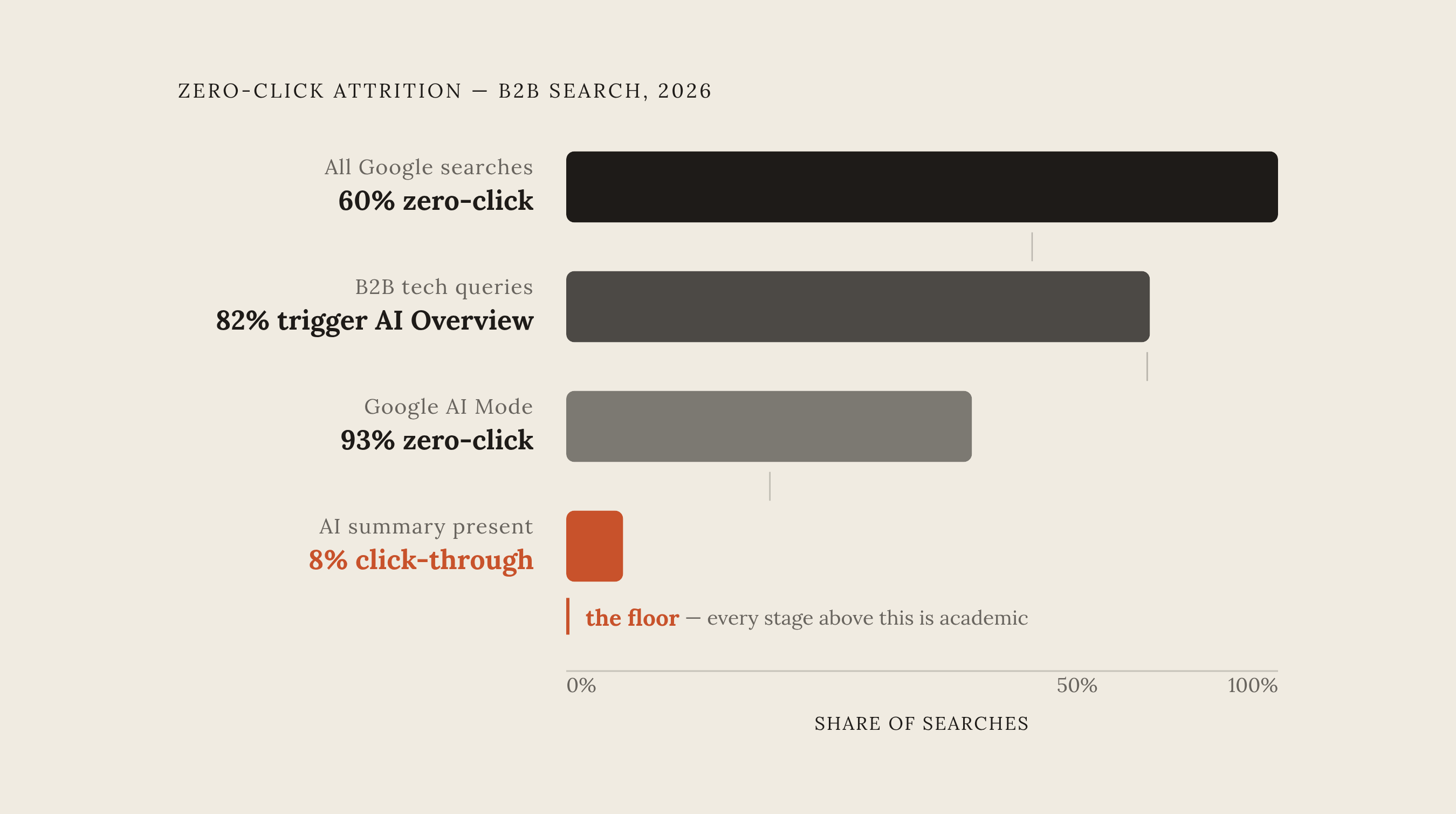
Google searches now end without a click to any website 60% of the time, up from 58% the year before B2B SEO Strategy in 2026: The 3-Pronged Strategy Framework That Works B2B SEO strategy: the complete guide for 2026. That's the baseline erosion figure, and it understates the disruption in categories B2B startups actually compete in: 82% of B2B technology queries now trigger an AI Overview. In Google's AI Mode specifically, 93% of searches end without a click at all Content Marketing for B2B SaaS Startups: The 2026 Playbook. Pew Research found that when an AI summary appears, users click through to a traditional result only 8% of the time, which confirms the aggregate numbers aren't a fluke of measurement, they reflect an actual change in how people read a search results page.
That sounds like good news until you realize every competitor has access to the same tools. The result is a market flooding with generic, competent, forgettable SEO content, which compresses the returns on the writing that used to be a startup's cheapest lever.
Some formats hold up regardless. Comparison pages, alternatives pages, and pricing pages survive because buyers need current, specific, experiential detail that an AI summary can't credibly fabricate on its own. Getting cited requires demonstrated authority, not keyword density, which is a different skill than the one most SEO playbooks were built to teach. AI-assisted workflows reduce blog costs by 78% and enable 8–12 posts monthly with minimal effort, according to Averi.ai, illustrating the flood problem in which lower production costs are flooding the market with generic SEO content and compressing returns further Content Marketing for B2B SaaS Startups: The 2026 Playbook. 50% of B2B software buyers now start their journey in AI chatbots rather than Google, according to a G2 survey of 1,000+ B2B software buyers, setting up why pre-SERP awareness has become the new frontier Averi.ai.
The causal chain that separates thought leadership from SEO content
Thought leadership means sharing an original insight or a genuinely informed point of view that changes how a reader frames a problem, not just an explanation of a topic they didn't already understand. The distinction from SEO content comes down to intent. SEO content informs; thought leadership tries to alter the reasoning process itself, so the reader who finishes it thinks differently about the category than the reader who started it.
In practice, thought leadership that actually does this work shares a few traits. It challenges an assumption the reader walked in holding, rather than confirming what they already believed. It ties a macro trend to a specific, immediate commercial consequence the reader is facing this quarter. And it carries the weight of someone who has actually done the thing being described, not someone who studied it from the outside.
The contrast is easiest to see side by side. A SaaS company publishing its own annual retention benchmark data, with a founder or product lead offering interpretation nobody else could offer, is thought leadership. Most of what gets labeled thought leadership inside B2B marketing departments is closer to the second example than the first, and the sequencing advice later in this piece assumes the real kind.
The causal chain runs differently from SEO too. Thought leadership builds trust before a buyer ever opens a search bar, which gets a company onto what's often called the day-one shortlist, the handful of vendors a buyer already has in mind before research even begins. Once a buying process starts, that early trust shortens the sales cycle and lifts win rates, because the buyer isn't evaluating a stranger anymore.
That clean measurement story shapes how budgets get allocated, a point this piece returns to later.
The evidence that thought leadership has measurable commercial impact, not just brand warmth
The skepticism toward thought leadership as a soft, brand-only exercise doesn't hold up against the data. Decision-makers trust thought leadership over traditional marketing material 73% of the time when they're evaluating a vendor, which is a credibility gap most startups underuse. Attention backs this up: roughly half of C-level executives spend an hour or more each week reading thought leadership content, a level of engagement most startup marketing teams don't plan for.
It also cuts both ways. That reframes thought leadership as more than an acquisition tool; it's a retention risk for incumbents and a retention opportunity for challengers, which is a use case most startups never build for. That gap between belief and execution is one of the clearer signs that most companies are leaving value on the table.
The honest caveat is measurement. Thought leadership moves pipeline rather than acting like a direct-response channel, so deal velocity, win rate, and brand search growth are the right signals to watch, but 71% of marketing executives say connecting social and content activity back to revenue is their single biggest measurement obstacle. That asymmetry, SEO's cleaner attribution versus thought leadership's fuzzier pipeline influence, creates a budget-allocation bias toward SEO even when thought leadership may be more effective at a given growth stage. According to Edelman-LinkedIn, 70% of C-suite leaders say thought leadership has at least occasionally led them to question whether they should keep working with an existing supplier, showing that thought leadership is not just acquisition content but retention threat and opportunity. According to TopRank Marketing/Ascend2's "Answer Engine: The State of B2B Thought Leadership in 2026" survey of 797 senior-level B2B marketers in the US and UK, 97% say thought leadership is critical to full-funnel success, yet only 43% extend it beyond acquisition to engage and retain customers post-sale, revealing the gap between what practitioners know and what they do.
How the two approaches are converging technically, not just strategically
The two tracks aren't just complementary in theory anymore, they're becoming mechanically entangled. Google and the large language models powering AI search increasingly weight human expertise signals, the experience, expertise, authority, and trust markers search engines group under E-E-A-T. AI search systems rank on more than topical relevance now; they weigh a brand's overall authority, and founder or subject-matter-expert thought leadership is what builds the entity authority that gets a company surfaced inside an AI-generated answer.
That means thought leadership has quietly become an SEO tactic. Original perspectives that credible sources cite generate the off-page signals that help a separate piece of SEO content rank and get cited. Run the logic in reverse and it holds just as well: SEO content with no thought leadership layer is becoming a commodity, because AI-assisted workflows make generic informational content trivially producible by every competitor simultaneously.
This closes the loop on the two-track SEO model described earlier. That is a technical reality, not a matter of taste or brand preference. It's a technical reality of how search and AI discovery rank and surface content today, and it's the real argument for running both tracks rather than choosing one.
How to sequence the two approaches across early startup growth stages
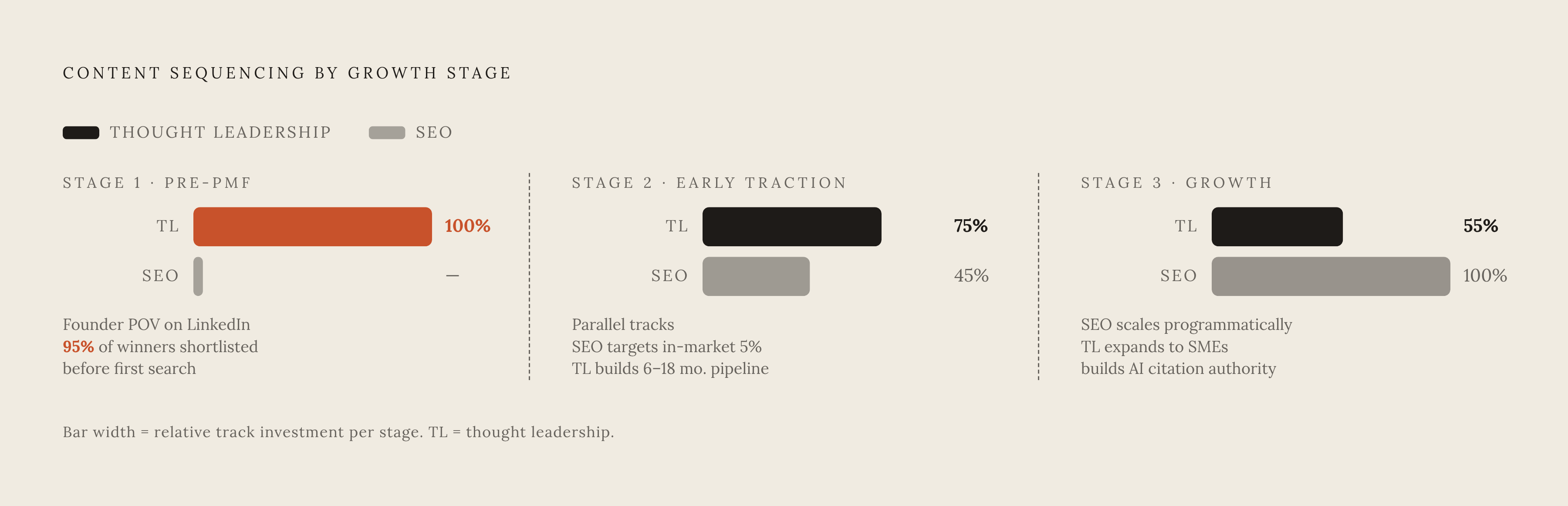
Before product-market fit, thought leadership should lead. There's no content library yet, no domain authority, no topical cluster to compound from, so SEO investment at this stage mostly gets wasted. What a pre-PMF startup has instead is a founder with a point of view, and LinkedIn is the right place to put it, carrying a 76% effectiveness rating for thought leadership distribution. The goal is getting onto the day-one shortlist, not traffic. It's getting onto the day-one shortlist, since 95% of winning vendors were already on a buyer's shortlist before that buyer ran a single search SeoProfy.
SEO content infrastructure (pillar pages, comparison pages, and use-case pages) targets the high-intent 5% of in-market buyers SeoProfy. At the same time, thought leadership should shift from founder opinion toward original research pulled from that early customer base, benchmark data no competitor can replicate because no competitor has that customer list.
At the growth stage, once revenue is repeatable and the team has expanded past the founder, SEO content can scale programmatically, integration pages, alternatives pages, segment variants, compounding long-tail traffic without a proportional headcount increase. Thought leadership, meanwhile, should extend past the founder to other subject-matter experts inside the company, building the broader authority layer that supports AI citation and off-page signal strength. Measurement infrastructure has to mature alongside both.
Starting with broad, generic educational SEO content before there's any clarity on ideal customer profile is the mistake that sinks startups. It produces traffic with no commercial intent behind it and no authority underneath it to compound from, and plenty of startups burn a year of runway learning that lesson the hard way. Early traction stage (some customers, emerging ICP clarity). The combination here is complementary: SEO captures active searchers while thought leadership builds the awareness-stage pipeline that will convert in 6–18 months.
What the distribution and format choices look like when both approaches run in parallel
Thought leadership distribution has a clear hierarchy. LinkedIn is at the top, with a 76% effectiveness rating. In-person events rate even higher among B2B marketers overall, cited by 52% as the single most effective channel, and webinars follow close behind at 51% effectiveness.
SEO format choices for 2026 follow their own hierarchy. Comparison and alternatives pages remain defensible against zero-click erosion because buyers need current, specific comparisons an AI summary can't reliably fabricate. Original research and data reports outperform opinion pieces by a wide margin, generating 67% more engagement, and they produce the backlinks and citations that build the domain authority everything else depends on. Pillar pages and topic clusters round out the format list, signaling topical authority to search engines and AI systems alike.
Production itself is shifting toward a 70/30 split: AI handles the structural, research-heavy scaffolding, while human editorial judgment shapes the perspective layer that actually gets a piece cited. That split explains why original research keeps surfacing as the format both camps are betting on. A proprietary benchmark report is the one format that ranks in search, builds authority, earns citations from other publications, and shortens a sales cycle, all from the same document. It is, in a real sense, where the two tracks stop being two tracks. According to TopRank Marketing/Ascend2's survey of 797 respondents, 47% of B2B marketers plan to increase use of original research and data-driven thought leadership in 2026, with original research sitting at the intersection of both approaches and anchoring the format strategy.
The measurement approach that makes both tracks defensible inside a startup budget conversation
SEO gives you clean numbers, keyword rank, organic sessions, conversion rate, while thought leadership's effect on pipeline is real but far harder to isolate in a spreadsheet. That gap is why even marketers who believe in thought leadership routinely underfund it relative to SEO. SEO Content Strategy vs Thought Leadership Content for B2B Startups.
For SEO content, track organic traffic growth by page cluster, keyword ranking movement, and leads generated, and hold the program against the benchmark of 702% median SEO ROI for B2B SaaS as a long-run target rather than a monthly expectation. For thought leadership, the indicators look different by design: brand search volume growth, share of voice in earned media and AI citations, pipeline influence tracked through CRM tagging and sales conversation notes, and deal velocity or win rate differences between segments where thought leadership is active and segments where it isn't.
SEO content, over time, funds itself through compounding organic return. Thought leadership is a different kind of investment, one aimed at deal quality and sales cycle length rather than volume, and both need to live inside the same measurement framework, or the harder-to-measure one will keep losing the budget fight by default.
None of this means measurement is a solved problem. Naming that limitation honestly, rather than promising an attribution model that doesn't exist yet, is what makes the rest of the argument credible to anyone holding the budget. Content marketing generates 3x as many leads as outbound at 62% less cost, per Demand Metric, cited across HubSpot, CMI, and DemandSage reports, a benchmark justified by the combined content program rather than either track alone. Note for writer: avoid implying that measurement is fully solved, since the 71% who struggle to attribute content to revenue represent the real constraint, and acknowledging it honestly builds credibility with the startup audience.